Researchers are passing on a rumour that OpenAI or Anthropic, or both, can factor integers in polynomial time, a result known as “factoring in P”. RSA, one of the most widely used public-key systems, relies on factoring being hard. No such result has been published, and we found no comment on the rumour from either company by 21:00 UTC on 25 November.
Who passed it on
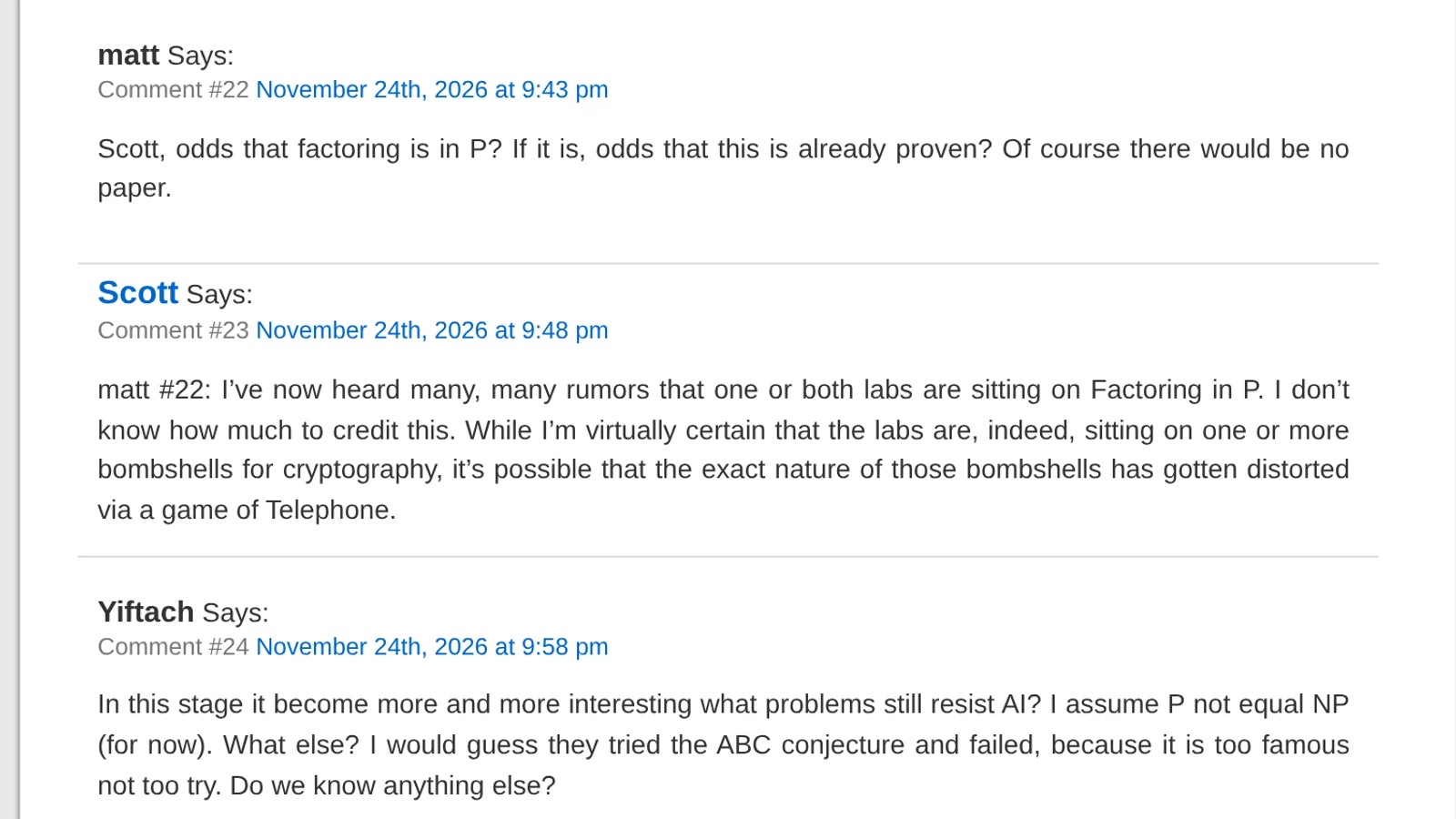
Scott Aaronson, a theoretical computer scientist at the University of Texas at Austin who worked at OpenAI from 2022 to 2024, was asked by a reader of his blog, Shtetl-Optimized, for the odds that factoring is in P. “I’ve now heard many, many rumors that one or both labs are sitting on Factoring in P. I don’t know how much to credit this,” he answered at 03:48 UTC on 25 November. He was “virtually certain that the labs are, indeed, sitting on one or more bombshells for cryptography”, though their exact nature might have “gotten distorted via a game of Telephone”.
At 13:56 UTC Andrew Curran, who writes about AI on X, posted: “Scott Aaronson on his blog. I have also heard this. In fact, this rumor has persisted for about ten days, about both Anthropic and OpenAI.” He ended: “This would crack RSA.”
Half an hour later Aran Nayebi, an assistant professor of machine learning at Carnegie Mellon University, quoted that post in a thread about Google’s factoring papers of the same morning:
Btw, this is the rumor I've been hearing as well for the past week, which is why the current factoring results were a bit of the let down, and may not be the full story
In a post at 19:01 UTC Aaronson repeated that he is “virtually certain, from multiple reliable sources” that the labs hold such bombshells. “However, until I either see details or hear directly from someone at a lab, I feel much, much less confident about the specific nature of those bombshells,” he wrote. “I do not wish to be responsible for spreading unverified rumors.”
What has been published
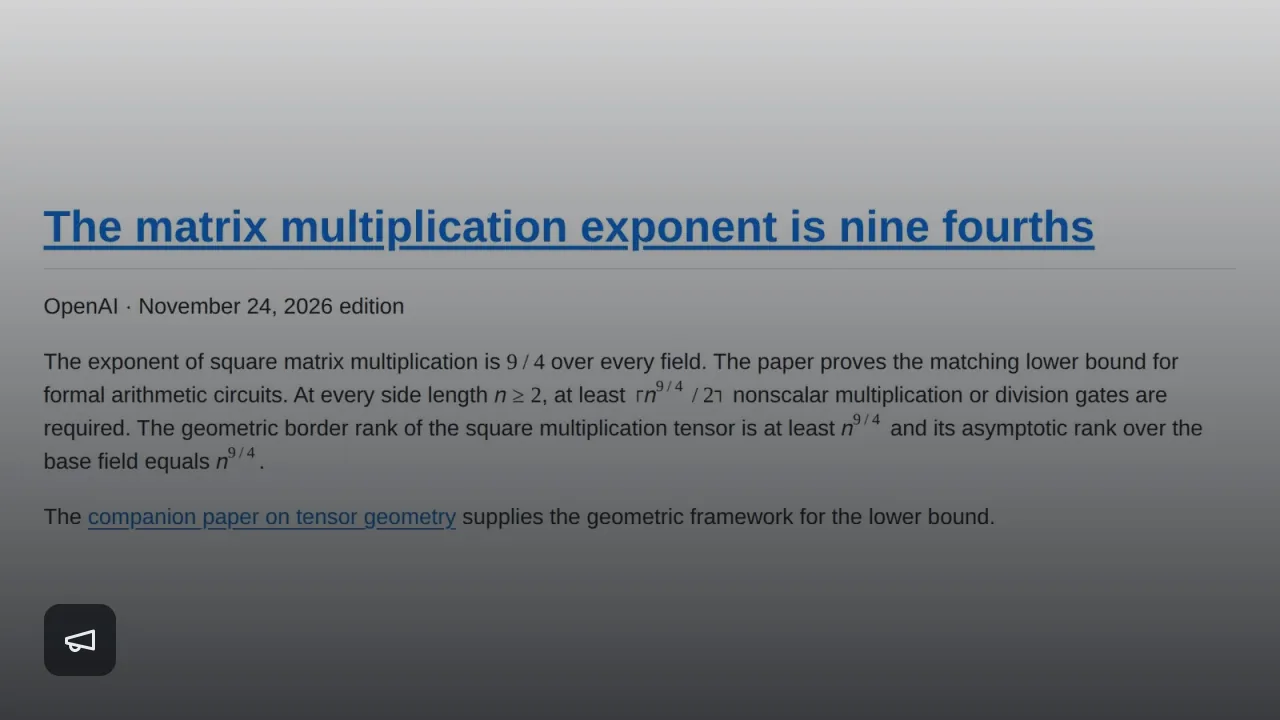
At 10:11 UTC Google Research put on GitHub six papers written by Cogentic, an AI agent built on Gemini 4, two of them on factoring. One proves, with no unproven assumptions, that every integer can be factored in expected time L_N[1/3, 105]. That is the speed class of the number field sieve, the method used in practice, whose running time of about L_N[1/3, 1.923] rests on heuristics. With a constant of 105 the new algorithm is far slower and gives no new way to break RSA keys. The week also brought OpenAI’s claim that the matrix multiplication exponent is exactly 9/4 and a proof of the Riemann hypothesis made with Claude, which mathematicians are still weighing.
- 20 NovemberRiemann hypothesisA Lean proof made with Claude is released
- 23 NovemberVP ≠ VNPAnthropic and OpenAI each post a proof of this algebraic analogue of P ≠ NP, without an announcement
- 25 November, 00:04Matrix multiplicationOpenAI claims the exponent is exactly 9/4
- 25 November, 03:48Aaronson's commentHe has heard rumours of factoring in P
- 25 November, 10:11Google's Cogentic papersSix papers, two of them on factoring
- 25 November, 13:56Andrew CurranHe has heard the rumour about both labs
- 25 November, 14:25Aran NayebiThe published results may not be the full story
- 25 November, 19:01Aaronson's postVirtually certain of bombshells, much less sure of what they are
What “factoring in P” would mean
“In P” means that an algorithm runs in polynomial time; a huge exponent or constant could still make it useless on real keys. A practical one would make longer RSA keys pointless, and RSA, still used for web certificates, code signing and SSH, would have to be replaced.
The ECDSA signatures of Bitcoin and Ethereum rest on another problem, discrete logarithms on elliptic curves, which a factoring algorithm would not break by itself. A quantum computer running Shor’s algorithm would break both, and NIST published its first post-quantum standards against that in August 2024. The Ethereum Foundation, which plans to move from elliptic curves to hash-based cryptography, wrote on 23 November that “recently AI emerged as a more urgent risk”, but “This does not immediately imply that AI can or will break the hardness assumptions that our cryptography relies on”.