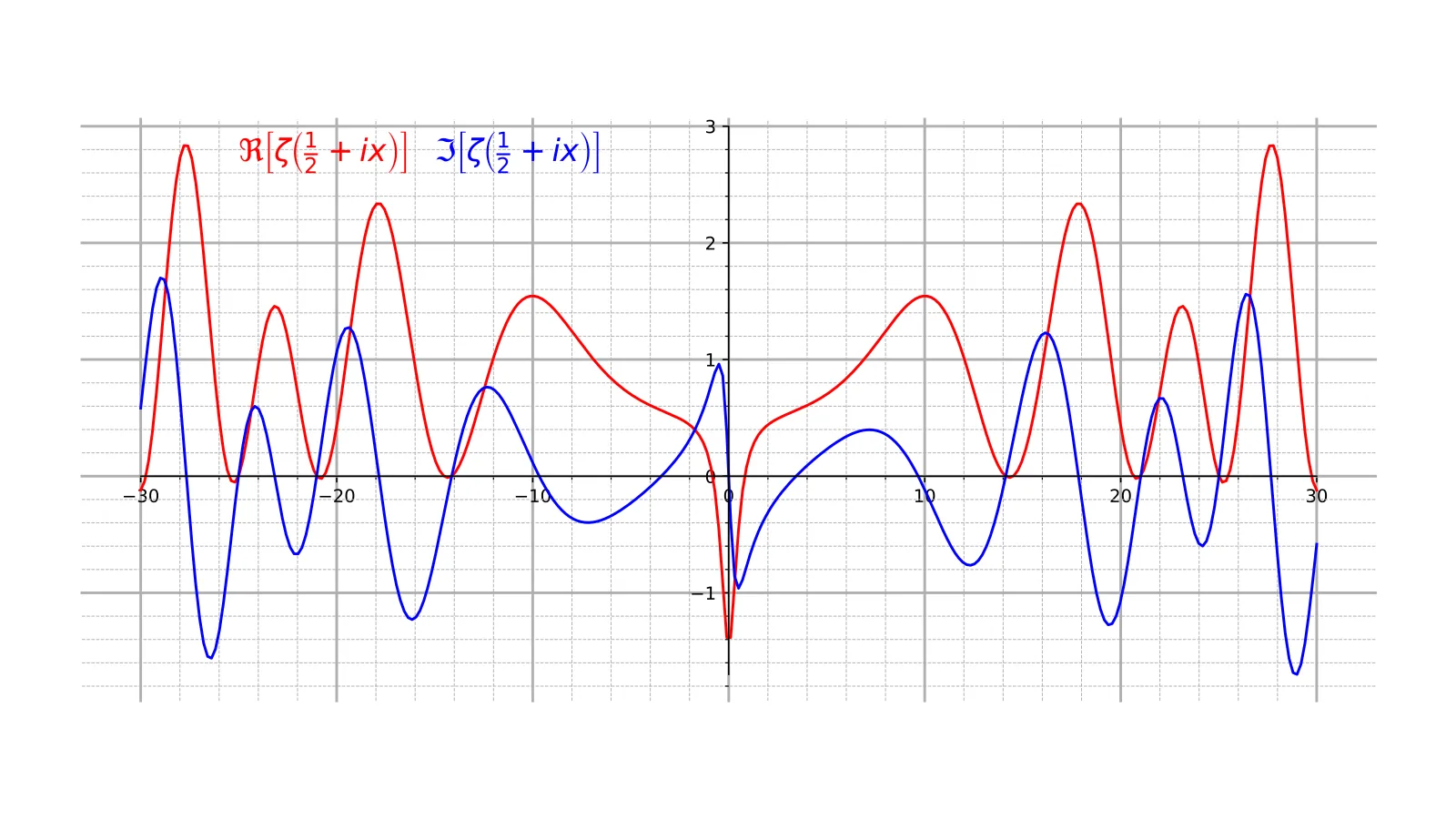
The hypothesis, posed in 1859, says every non-trivial zero of the zeta function has real part 1/2; it governs how evenly the primes are spread. Alpöge, a number theorist who came to Anthropic from the Harvard Society of Fellows, announced the result in a four-page note on his site.
I believe I have, working with Claude, discovered a proof of the Riemann Hypothesis. In fact, the method easily extends much further, resolving the so-called Generalized Riemann Hypothesis, and I expect, with more time, the Extended Riemann Hypothesis too.
 Levent AlpögeMathematician, Anthropicnote on alpo.ge, November 20, 2026
By his account he steered the argument and Claude did much of the technical work near the end, in fields he says he has not mastered. He published only the Lean code; a generated write-up ran past 250,000 pages.
What the certificate covers
The joint statement, endorsed by the Lean FRO and the Mathlib Initiative, reads: “We hereby certify that both the statement and the proof of the Riemann Hypothesis are correct.” The library depends directly only on Mathlib, Lean’s shared library of mathematics, and proves Mathlib’s own statement of the hypothesis. Two tools matched the theorem to that statement, and Lean’s kernel, the con-leche and con-ron checkers and independent checkers in other languages accepted the proof. The checks ran on an inert export, out of reach of any malicious code.
Andrew Sutherland of MIT, who published his own runs, notes the scope: the generalised hypothesis here is the one for Dirichlet L-functions, not for automorphic L-functions in general.
What is still open
The Lean statement looks forward to work “that will help explain the new ideas in this proof”. Brian Conrey, a specialist on the hypothesis, told AFP that “it looks like it’s seriously complicated” and that “there will be simpler ways to do it”. The $1 million prize of the Clay Mathematics Institute requires publication in a peer-reviewed journal and two years of scrutiny.
A draft written without AI
Vakil, a Stanford professor and president of the American Mathematical Society, posted the draft by Masullo, a postdoctoral researcher in his department. Brian Conrad had been examining it for months.
It is all human, with no AI. The hope was to have Brian work with Alessandro for a year to polish the writing and then announce it after running it by enough people.
 Ravi VakilMathematician, Stanford University; president of the American Mathematical SocietyMath 216 blog, November 20, 2026
About eight hours later Vakil added that several people had reported problems in the draft, which runs past 900 pages, found with the help of AI models. He makes no claim as to the correctness of the proof strategy.
Alpöge writes that he will work to understand the argument, “to speak about it, to write it properly”, and expects shorter proofs to follow.