Shinji Mikami wishes AI would "all just go away"; Kim Hyung-tae says games can't avoid it

At G-CON 2026 in Busan on 19 November, the director of the first Resident Evil and the head of Shift Up described how their studios use AI. Mikami keeps it away from design; Kim said game development without it no longer exists.

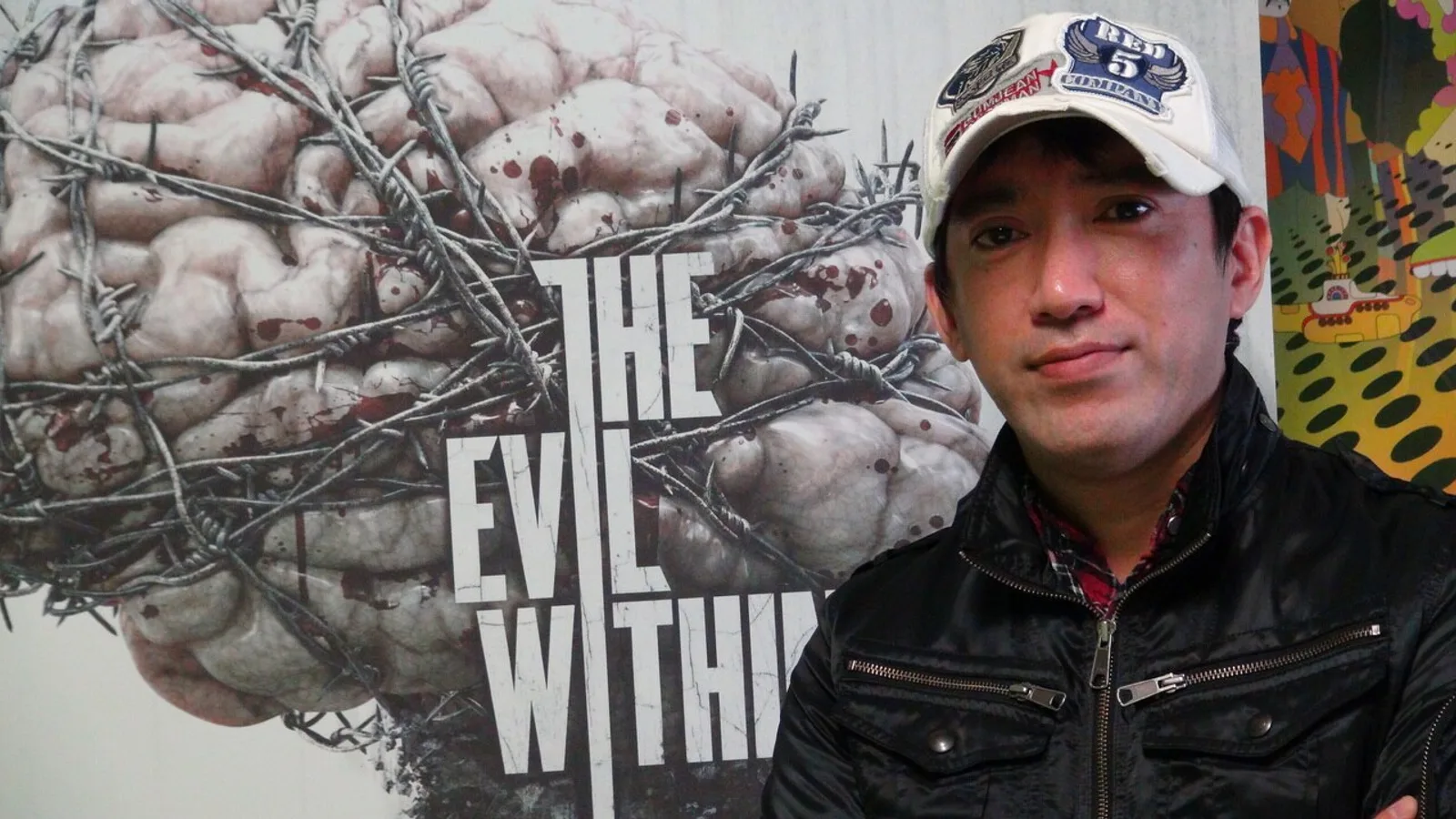
Shinji Mikami in a white cap in front of a poster for The Evil Within, 2014
Photo: AlberKennedy / Wikimedia Commons (CC BY-SA 4.0)
In this material
  1. Shift Up’s rule
  2. Looking at 2027

The talk at BEXCO, “Kim Hyung-tae and Shinji Mikami: A Conversation on Making Games in 2027”, went through combat, visuals, AI and Mikami’s next game. The two now share a group: Shift Up bought Unbound, the studio Mikami founded in 2022, a year before he left Tango Gameworks, earlier this year. Mikami spoke Japanese and Kim Korean. When the talk reached AI, Mikami first said he did not mean games alone, 4Gamer reported:

If only AI would all just go away.

AIが全部なくなればいいのになぁ

Shinji MikamiGame director, founder of UnboundG-CON 2026 talk, in Japanese, as reported by 4Gamer, November 19, 2026Translated by the editors

In practice, he went on, AI used well often gives better quality for the same budget, so Unbound is trying it out. Design stays with people. An artist draws an enemy, AI turns the drawing into a 3D model, and the team puts it in the game. About 20 minutes later they know whether it works and hand it to a modeller. Before, a model could take about a month and then fail to match the drawing, which sent the design back to the start.

Five or ten years from now, I can't say. I think there is quite a real chance that a time will come when we lose our jobs.

5年,10年先というのは分からなくて,僕らが職を失う時代が来る可能性も,結構あるんじゃないかなというふうに思っています

Shinji MikamiGame director, founder of UnboundG-CON 2026 talk, in Japanese, as reported by 4Gamer, November 19, 2026Translated by the editors

Shift Up’s rule

Kim said AI already runs through programming, QA, code review and debugging, and is hard to avoid in visuals. On 31 July Shift Up’s YouTube channel released an AI-made music video of Evie, the heroine of Stellar Blade: Blood Rain, and many fans disliked it, Automaton reported. Kim said the backlash taught the studio what players accept in a finished product.

Since then, Inven reports, the internal rule has been “start by human hands, finish by human hands”. A team that starts with AI starts level with every other AI user, Kim said, so artists begin a piece, AI handles steps in between such as texture weathering and retopology, and people finish it before it goes into a game. AI renders of monster sketches also make it easier to turn a draft down than when someone has worked on it all night:

It's not that I couldn't cut them. I cut them, and I felt sorry.

커트 못 하진 않고 커트하고 미안하죠

Kim Hyung-taeArtist and game director, founder and CEO of Shift UpG-CON 2026 talk, in Korean, as reported by Inven, November 19, 2026Translated by the editors

Looking at 2027

Kim expects many AI-made games by 2027, some of them surprising, and thinks handmade games that took far too long to make will stand out because of them. Mikami expects AI characters that talk and behave like living ones, rather casual at first. He added that at Shift Up’s office he saw staff building everything from hand-drawn designs, and felt a little sorry that so many people misunderstand Kim.

The talk came in a month of arguments over AI in games: Big Walk drew negative Steam reviews over a few lines of chatbot-assisted code. Mikami’s next game, which he described as a refined other world with cruelty mixed in, has no announced date.

From the pulse

All news →
  1. Studios

    GDC survey: 40% of game developers use generative AI at work

    The State of the Game Industry report for November 2026 surveyed more than 2,600 people in 69 countries; the share using generative AI rose from 36% a year earlier, mostly outside the United States. Of those who use it, 73% name research and brainstorming and 56% code, while only 6% make content that players will see; 27% of respondents at AAA studios say they are encouraged or pressured to use it. The figures are self-reported and do not show how much of a finished game the tools touch.

    Sources: gamedeveloper.com, gamingonlinux.com

  2. Games

    House House: well under 0.1% of Big Walk's code involved AI chatbots

    The studio published the disclosure after a group of Independent Games Festival jurors said they would not vote for any game made with generative AI. It says chatbots were used late in development to research problems with third-party code, that snippets were adapted in a few cases, and that generative AI was not used anywhere else in the game. The store page has no AI note because Steam does not ask about code; how the festival will treat such entries is not known, and finalists are due in January 2027.

    Sources: gamesindustry.biz, kotaku.com

  3. Mods

    Nexus Mods makes AI disclosure mandatory and rules out a ban

    Every new upload must now state whether generative AI was used, and AI-assisted mods must explain publicly how and where; mods already on the site have until 2 January 2027. Site owner Foledinho wrote "We are pro-human creativity" and said an outright ban would only stop authors from mentioning AI. Checks are manual and rely on user reports; how undisclosed AI will be found otherwise is not explained.

    Sources: gamingonlinux.com, videogameschronicle.com

More in this section

All materials →
News

Cliff Bleszinski on Big Walk's AI backlash: "People really need to get over themselves"

House House said an AI chatbot helped with about 10 lines of Big Walk's code after IGF jurors refused to vote for games made with generative AI. Negative Steam reviews followed, and the Gears of War designer took the studio's side.

News

Gemini 4 Neon is "#1 overall" for coding agents, says Google's Koray Kavukcuoglu

Google released Gemini 4 Neon on 18 November 2026. Its launch post ranks the model first on the Artificial Analysis Coding Agent Index and third on its Intelligence Index; the benchmark's own pages show a lead of 0.1 points in coding and a sixth place among 95 entries.

News

OpenAI ships GPT-6.2 Astra, its first public model rated High for self-improvement

OpenAI released GPT-6.2 Astra and Sol on 17 November 2026. Its system card makes Astra the first model the company has released that meets its own High threshold for AI self-improvement; Epoch AI's test of real work tasks put it at 65%.