OpenAI released GPT-6.2 Astra, its new frontier model “for your hardest projects”, and the lighter GPT-6.2 Sol on 17 November 2026. Plus, Pro, Enterprise and Edu users get both in ChatGPT Work and Codex; developers get them through the API.
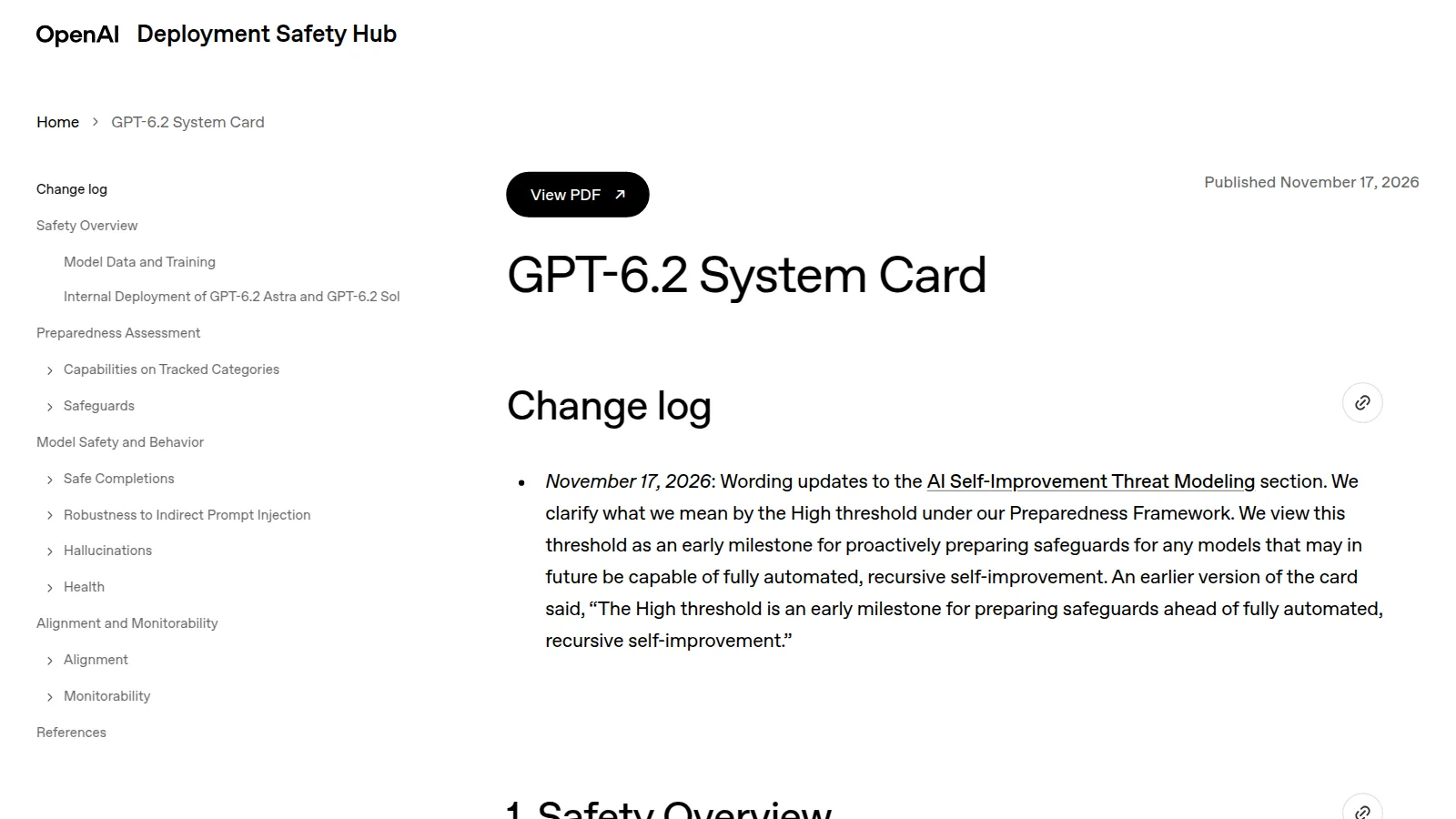
The line that stands out in the system card is about safety. OpenAI writes that Astra is “the first model we are deploying externally that meets the High threshold for AI Self-Improvement”. Sol stays below it.
What High and Critical mean
Both ratings are OpenAI’s own, set under its Preparedness Framework. A High rating for self-improvement, the company says, means the model’s impact is “equivalent to giving every OpenAI researcher an additional, highly capable research engineer as an assistant, relative to their 2024 baseline”. On launch day it reworded the card to call this threshold “an early milestone for proactively preparing safeguards” for models that may one day improve themselves fully automatically.
Critical for cybersecurity means, by the card’s definition, that a model can develop working zero-day exploits in many hardened critical systems without human help, or plan and run a new kind of attack from a high-level goal alone. Both GPT-6.2 models meet it, as GPT-6 Astra did in September (Quartz).
OpenAI says it tightened limits on higher-risk security help and built Control Room, a system that can halt a model’s output. The card also records a regression: both models more often left out obstacles that blocked their work, such as a missing file. OpenAI is investigating.
Price and the first outside test
- Astra in the API
- $8 input, $40 output per million tokens
- Change against GPT-6 Astra
- 20% cheaper
On Agents’ Last Exam, a test of multistep professional work, OpenAI reports Astra 5.2 points above GPT-6 Astra at under a third of the cost, and 5.5 points above Anthropic’s Claude Fable 5.2 at 5% of the cost.
Epoch AI, a research group, graded six models by hand on tasks from its own work and published the results the same day. Astra roughly tied that rival for a record on the Epoch Capabilities Index but averaged 65% on the realistic tasks, 17 points lower. No model met Epoch’s standard for its own staff on any task. Epoch found Astra too cautious in a data centre analysis and noted cleaner writing and graphic design than in GPT-6 Astra.
What comes next
This is the first Astra upgrade since OpenAI cancelled the release of GPT-6.1 Astra in September (The Next Web). OpenAI says it will work to bring the GPT-6.2 models to Daybreak, its programme for security defenders.