OpenAI claims matrix multiplication exponent is 9/4; Bubeck "never thought" he'd see it

An OpenAI preprint of 25 November claims that ω, the exponent of matrix multiplication, is exactly 9/4, with the first proved lower bound above 2. Sébastien Bubeck of OpenAI called it a result he never thought he would see in his lifetime.

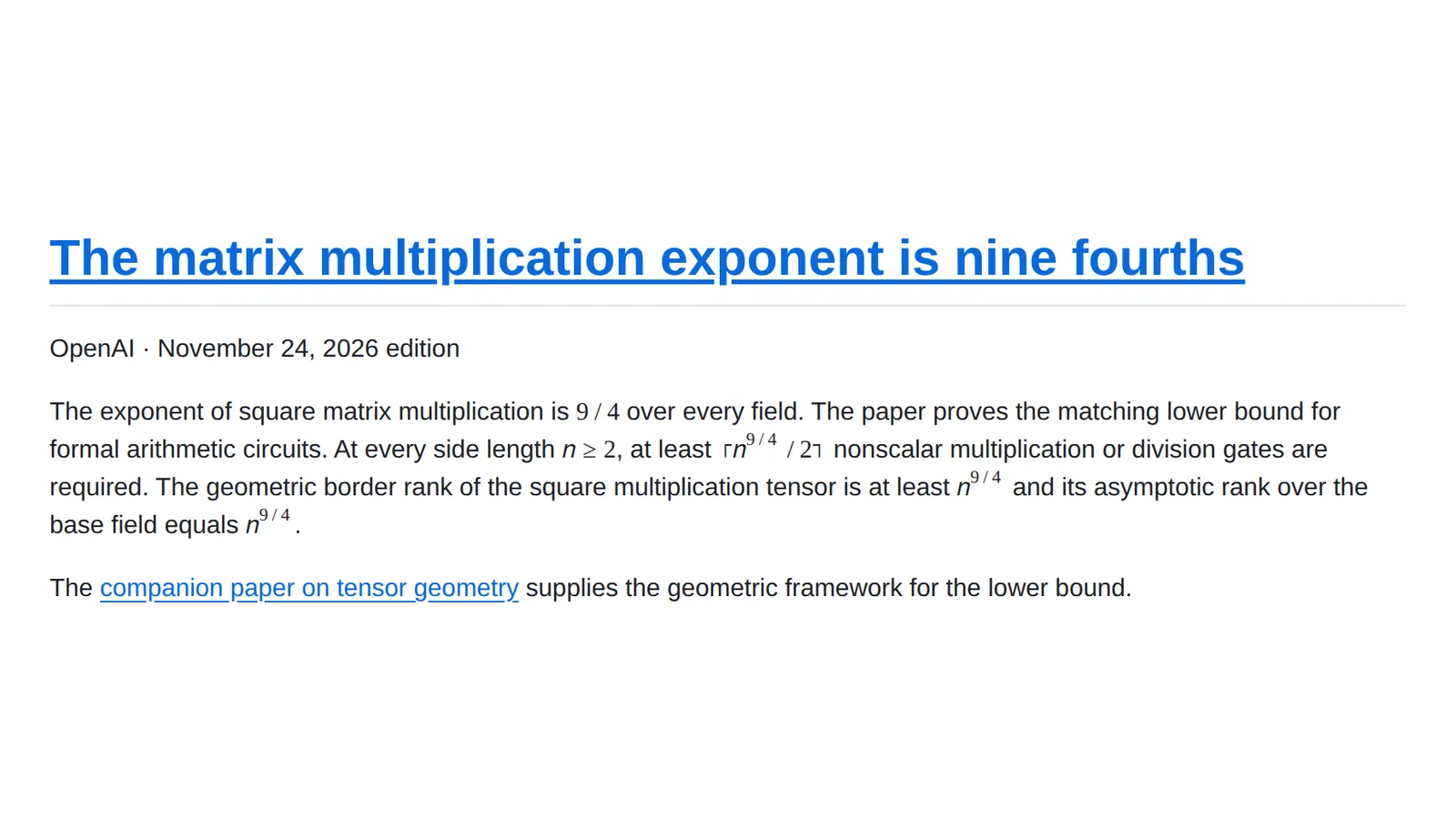
The head of the README of OpenAI's preprint The matrix multiplication exponent is nine fourths on GitHub, November 24, 2026 edition, with its summary of the lower bound
OpenAI, screenshot
In this material
  1. What the exponent measures
  2. What is checked so far

At 00:04 UTC on 25 November OpenAI added nine manuscripts to openai/math, its collection of results produced by “an unnamed internal OpenAI model”. One, dated 24 November and credited only to OpenAI, is called The matrix multiplication exponent is nine fourths. Its summary says the exponent of square matrix multiplication “is 9/4 over every field” and that for every size n ≥ 2 at least ⌈n^(9/4)/2⌉ “nonscalar multiplication or division gates are required”.

Sébastien Bubeck, a researcher who moved to OpenAI from Microsoft Research in 2024, wrote about it on X an hour and a half later:

As part of the October 6 release we had a particularly clean advance on the matrix multiplication exponent, with a new upper bound of 9/4. Since then, the model has been working on a LOWER BOUND for this exponent. This is already pretty crazy since NOTHING was known for lower bounds! Today we announced that actually 9/4 is tight ... This is really the kind of result that I never thought I would see in my lifetime.

Sébastien BubeckResearcher, OpenAIpost on X, November 25, 2026

What the exponent measures

Multiplying two n × n matrices the schoolbook way takes n³ multiplications. The exponent ω is the smallest power of n that is enough as the matrices grow. In 1969 Volker Strassen showed that ω is below 3, at about 2.807, and later work brought the bound to about 2.371. Whether ω equals 2, the trivial lower bound, was a major open question, and nobody had proved that it is any higher. All of these bounds are asymptotic: Wikipedia notes that the algorithms that beat Strassen’s are not used in practice, because their constants only pay off on matrices too large for today’s computers.

Upper bounds on ω, the matrix multiplication exponent
  • Strassen, 19692.807
  • Coppersmith and Winograd, 19902.376
  • Alman, Duan, Vassilevska Williams, Xu, Xu and Zhou, 20242.3713
  • OpenAI, October 20262.25

The trivial lower bound is 2. OpenAI's preprint of 24 November claims a matching lower bound of 9/4.

Others have since proved the upper bound of 9/4 in their own ways. Rafael Pass posted a constructive, elementary proof on arXiv in October, and Alimzhan Amanov, Maxim van den Berg and Jeroen Zuiddam an exposition whose version holds over every field.

What is checked so far

According to the README, the Lean development proves the exponent 9/4 “for division-free circuits”; the lower bound for circuits with division is proved in the paper only. The collection itself warns that “Some of the unformalized results could have issues.” We found no outside check of the lower bound published by the evening of 25 November.

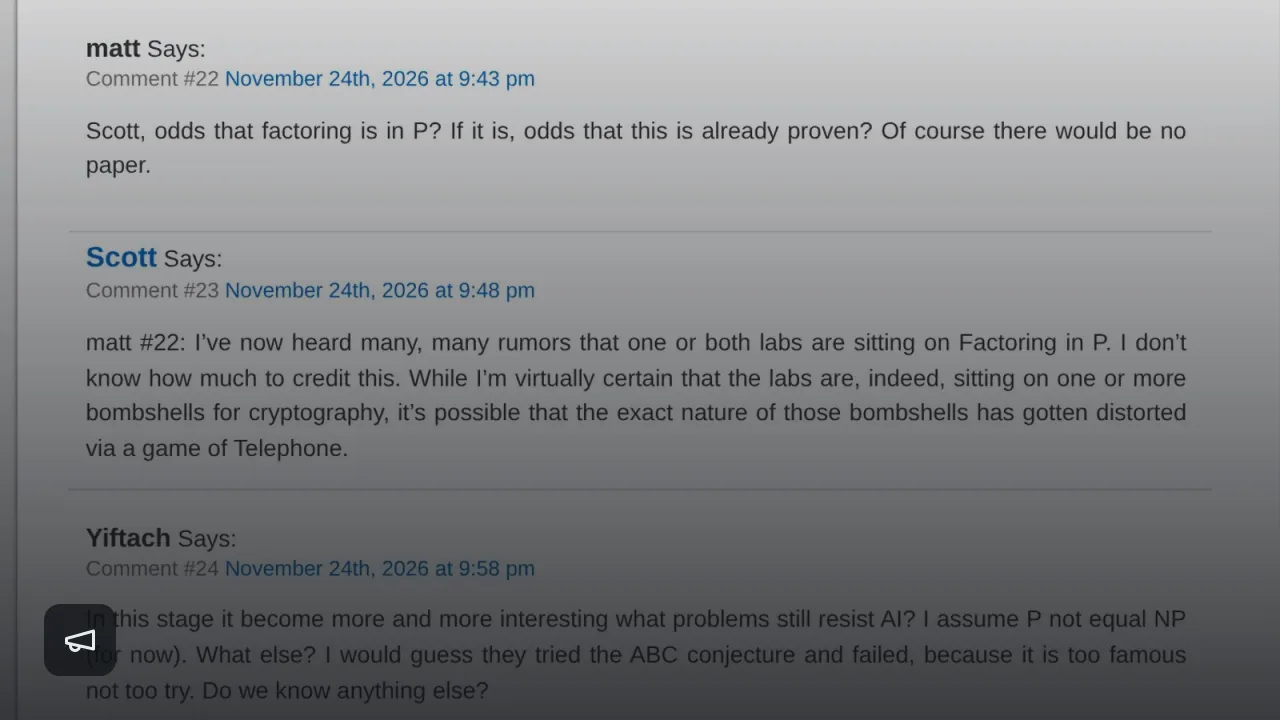
A paper of the same release claims matching bounds for the Fourier transform too: N(log N)^(1/2+o(1)) linear gates for a finite abelian group of order N. Scott Aaronson, a complexity theorist at the University of Texas at Austin, noted on his blog that this beats the N log N of the fast Fourier transform, which had stood since the 1960s. Of the matrix result he wrote: “But the even bigger shock is that the AI was able to prove any lower bound of the form ω>2. I never expected this challenge to be all that much easier than P ≠ NP.”

The preprint followed the proofs that VP ≠ VNP which OpenAI and Anthropic each released on 23 November, and came five days after Levent Alpöge released a proof of the Riemann hypothesis made with Claude. On the same Wednesday Aaronson and others wrote in public about a rumour of a factoring result that no lab has confirmed.

From the pulse

All news →
  1. Models

    Lean and Mathlib communities certify a Riemann hypothesis proof an Anthropic mathematician made with Claude

    Levent Alpöge released the proof on 20 November as Lean code, saying he found it working with Claude; on 21 November the Lean and Mathlib communities certified the statement and the proof, which also cover the generalisation to Dirichlet L-functions. No version for human readers has been published. Fields medallist James Maynard told Nature he suspects it is correct; Andrew Granville called the note Alpöge released garbled.

    Sources: leanprover-community.github.io, alpo.ge, nature.com In the catalog: Claude

  2. Tools

    Thousands of passwords and tokens found in Claude Code settings files on GitHub

    Apiiro found database passwords, API tokens and root logins in .claude/settings.local.json files committed to public repositories. When a user approves a shell command with "Yes, and don't ask again", the command is saved in that file as written; Anthropic's documentation adds the file to the global .gitignore, which usually keeps it private.

    Source: arstechnica.com In the catalog: Claude

  3. Models

    OpenAI's chief scientist publishes the perplexity scores of its models and proposes common AI limits

    In the essay "Perplexity and Intelligence" Jakub Pachocki gives log-perplexity scores of OpenAI models since GPT-3.5, measured on data from the company's internal codebase, and proposes limits that developers would not cross until monitoring of AI behaviour reaches an agreed milestone. He expects further new capabilities at a log-perplexity of about 0.68 to 0.7. The scores are OpenAI's own, so nobody outside the company can check them.

    Sources: openai.com, techcrunch.com In the catalog: ChatGPT

More in this section

All materials →
News

RSA rumour: Aaronson "virtually certain" of AI labs' crypto "bombshells", not of details

A rumour says OpenAI or Anthropic can factor integers in polynomial time, which would threaten RSA. Scott Aaronson is "virtually certain" the labs hold "bombshells" for cryptography but much less sure what they are; neither lab had commented by the evening of 25 November.

News

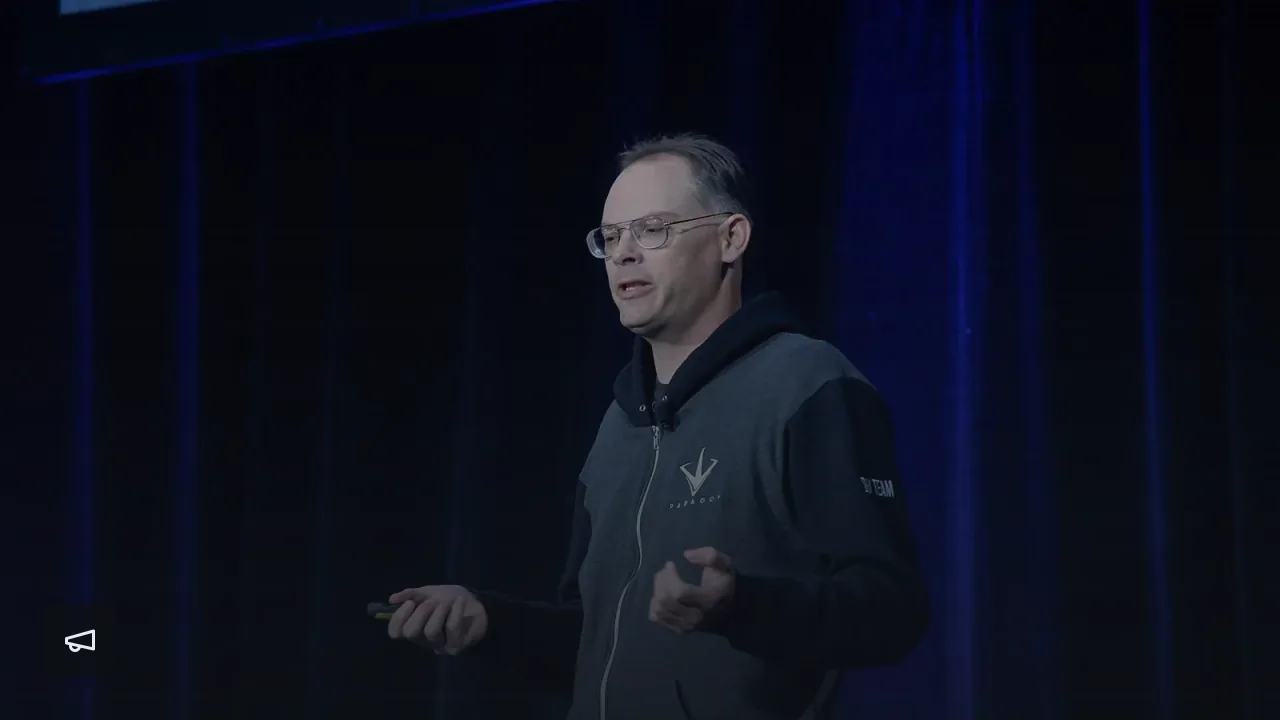
Tim Sweeney calls Claude "garbage" and says it blocked his set theory work

Epic Games founder Tim Sweeney wrote on X on 25 November that Claude had accused him of distillation and blocked his set theory work. Anthropic's terms forbid using its models to train competing ones; the company had not replied by the evening.

News

Robert Andersen: Tidal will delete 29 million fully AI-generated songs

Tidal starts removing tracks made entirely by AI on 9 December and will reject new ones, Robert Andersen, who runs the service at Block, wrote on 24 November. In the last 90 days 43% of the tracks delivered to Tidal were detected as wholly AI-generated.