In this material
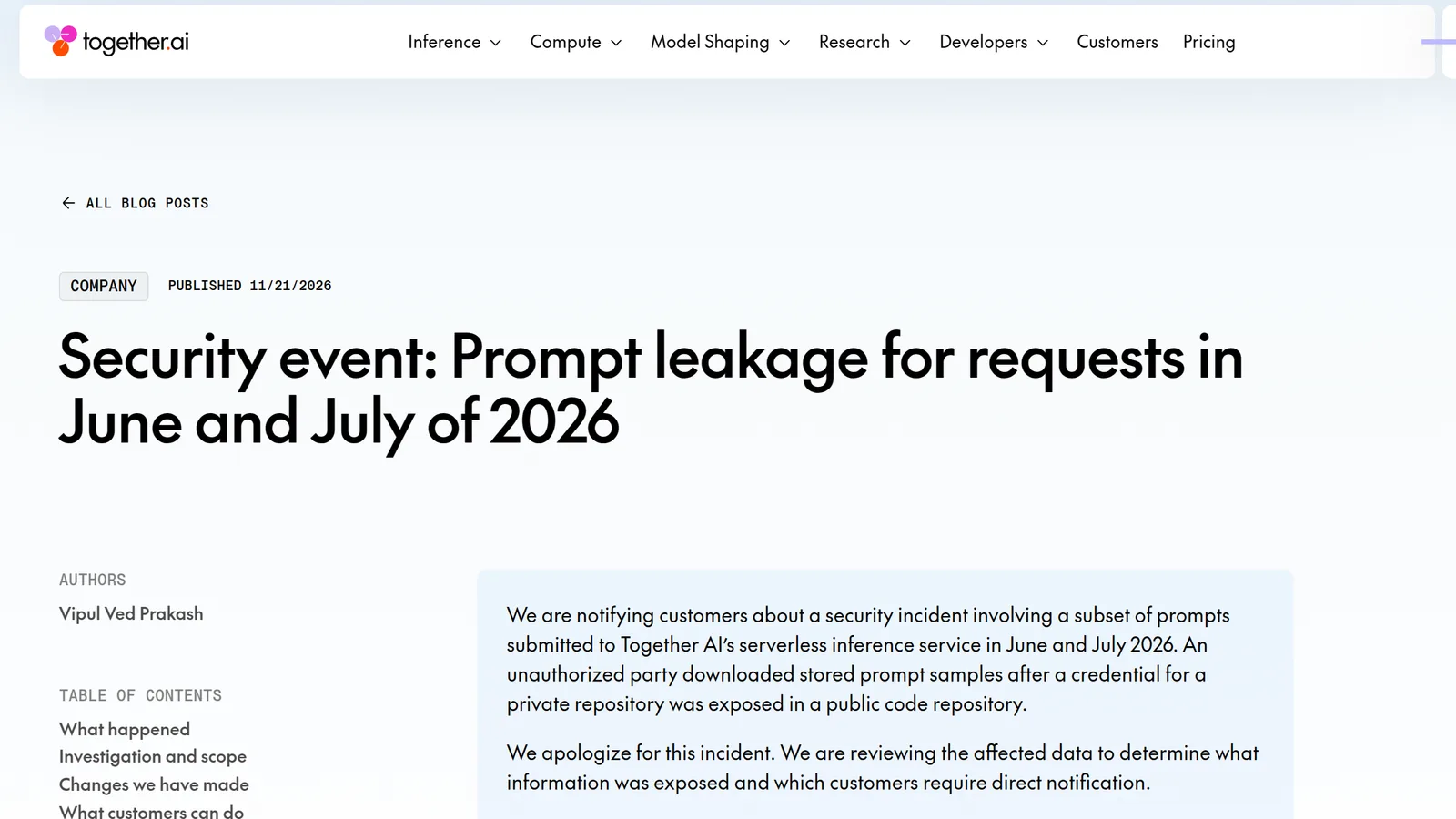
Vipul Ved Prakash, chief executive and co-founder of Together AI, signed the notice on 21 November, two days after HD Moore of Dragos showed how planted secrets exposed breaches and leaks at AI providers (our story).
Together kept prompt samples in a private Hugging Face repository for routine software testing, a use it says they were authorized for. While the company was developing xorl, “an AI coding agent committed a credential that provided access to the private Hugging Face repository,” the notice says. Automated scanning caught it and the commit was reverted, but someone had already obtained the credential, downloaded the samples, searched them for credentials to other services and tested whether those worked. The notice does not say how long the credential stayed public.
One line of the advice that ends Moore’s report reads:
Keep in mind that a privacy flag only binds the first hop, and that AI agents will happily send whatever they can read, including credentials.
 HD MooreChief research officer, Dragos; creator of MetasploitDragos blog, November 19, 2026
What Together has changed
Together says an outside forensic firm and law enforcement have helped with the investigation and no other prompt leakage has turned up. It is still reviewing the stolen prompts for sensitive personal information and other customer data, and will contact affected customers directly. Its credentials are now scoped or short-lived, every pull request is checked for credentials, new accounts get zero data retention by default, and its development processes for AI coding agents have been updated.
Three providers off OpenRouter
OpenRouter, which passes each request on to one of many hosting providers, says the findings showed no breach of its own systems. Its announcement of 22 November lists what it has done: three providers off-boarded “based on the results of our investigations”, 125 endpoints removed from Zero Data Retention eligibility, some of them as a precaution, and every customer who may be affected notified. The providers are not named.
The page links the notices published so far. Besides Together’s, Novita wrote on 22 November that a routing error sent some MiniMax requests to MiniMax’s own API, so prompts sent that way from 28 May to 11 November may have been accessed or kept by a third party. Phala reported on 10 November that an intruder took control of the server running its DeepSeek V4 Flash 0731 deployment; requests sent to it from 21 October to 8 November should be treated as exposed. “Not all affected providers have posted publicly,” OpenRouter writes.
It is now adapting the researchers’ tests to run them all the time, and a removed endpoint will not get zero retention status back without “appropriate assurances and validation”.