Edmund McMillen on AI music in The Binding of Isaac: "I had no idea"

Players found Suno metadata in the music of a GTA-themed Daily Run that The Binding of Isaac: Repentance+ got on 19 November. The game's creator said he had not known, recent Steam reviews fell to 8% positive, and a PC update took the tracks out.

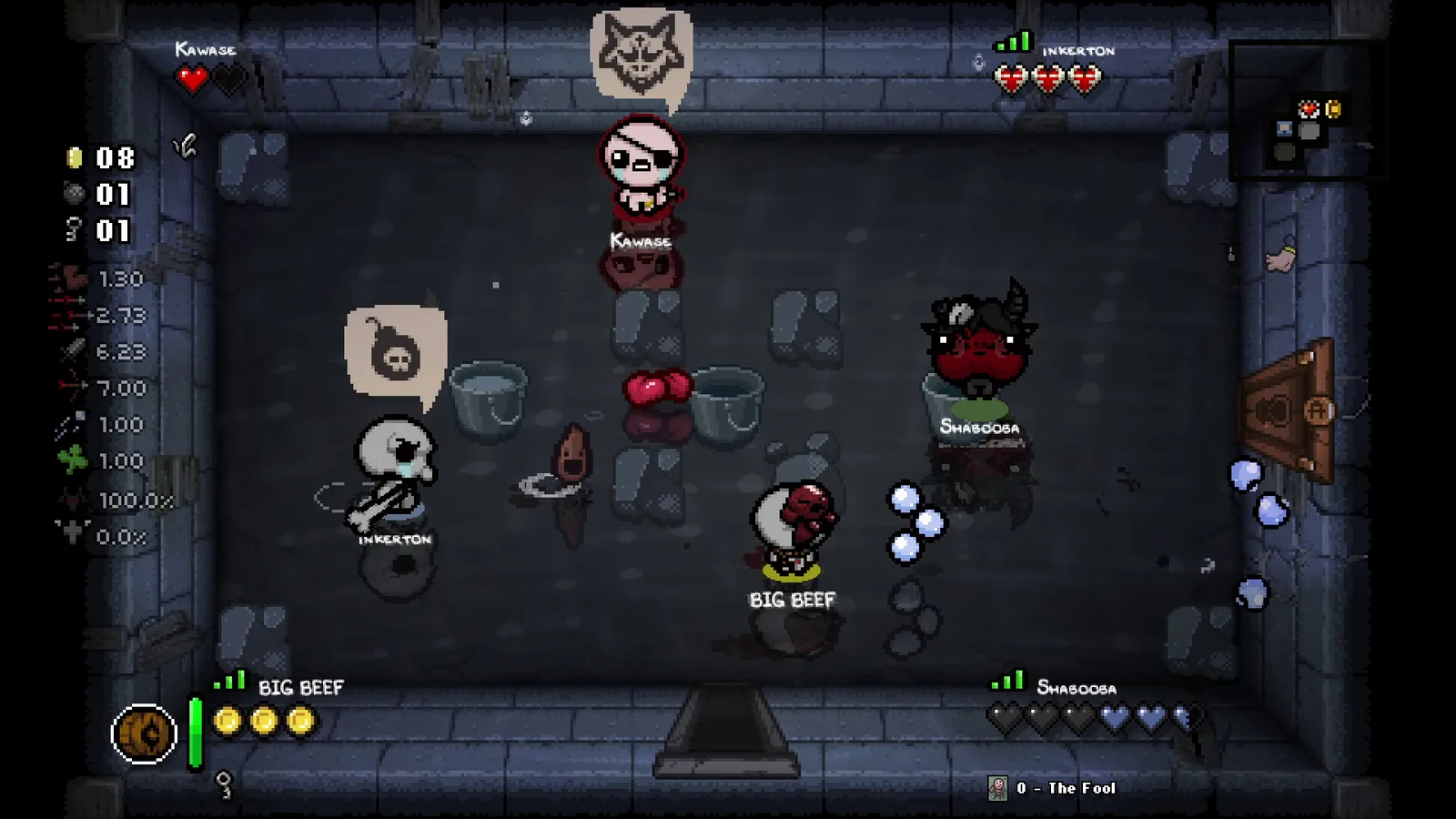
Four players' characters in a stone basement room of The Binding of Isaac: Repentance+ in online co-op, a screenshot from the game's Steam store page
Picture: Edmund McMillen / Nicalis
In this material
  1. A crime-themed daily run
  2. Reviews and the patch
  3. What comes next

Edmund McMillen, the designer who created The Binding of Isaac, says he did not know that AI-generated music had shipped in his game. He wrote on X on 21 November at 15:52 UTC, in a post viewed about 1.1 million times by 23 November:

[…] obviously I had no idea it featured generated music in the daily run, looking into how that happened and getting it removed, stay tuned.

Edmund McMillenCreator of The Binding of Isaac, co-creator of Super Meat Boypost on X, November 21, 2026

A crime-themed daily run

Repentance+ is a free expansion of The Binding of Isaac: Rebirth, developed by Nicalis with McMillen. It came to PlayStation 5, Xbox Series X|S and Switch 2 on 19 November, the day Grand Theft Auto VI launched. The Steam version got bug fixes the same day, and the game’s announcement on Steam sent players into that day’s Daily Run “for a very special crime-packed surprise”. According to Kotaku, the seed “V1CE BSMT” also starts the GTA-inspired run, with its own weapons and music.

A Reddit user then went through the 14 music files of the run, seven songs and their intros and outros, Kotaku and GamesRadar+ report. Some files still carried the comment “made with suno” in their metadata, with a creation date of 30 October 2026.

Reviews and the patch

Both outlets link the finding to a wave of negative Steam reviews. When we read the store page of Repentance+ at 00:22 UTC on 23 November, its recent reviews were Overwhelmingly Negative: 8% of 1,712 reviews from the last 30 days were positive. Its English reviews overall were Mixed, 47% positive out of 3,424. The base game, Rebirth, still had 84% positive recent reviews. The reviews that Kotaku and GamesRadar+ quote also complain about bugs.

Kotaku reported on 21 November that an emergency update had already gone out. GamesRadar+ says the PC patch removed the “generated music files” and brought bug fixes and netcode improvements. Nicalis has not explained how the tracks got into the game, both outlets note.

Steam asks developers to disclose generative AI content that “ships with your game, and is consumed by players”, which PC Gamer reads as covering final art, sound and writing. The store page of Repentance+ carries no such disclosure. Earlier this month the same form came up with Big Walk, whose studio had disclosed nothing on Steam because an AI chatbot had helped only with code.

What comes next

For the console versions, the update has been “submitted to Microsoft, Nintendo and Sony ASAP”, according to GamesRadar+. Nicalis is also fixing compatibility with player mods, which had been broken by accident, the outlet adds.

From the pulse

All news →
  1. Games

    AI-generated music in a Binding of Isaac update is removed in an emergency patch

    The update of 19 November added a GTA-themed Daily Run with 14 music files; a player found Suno metadata in some of them, and user reviews of Repentance+ on Steam fell to 9% positive. Creator Edmund McMillen wrote that he "had no idea" the run used generated music and later said the idea came from publisher Nicalis, which has not explained how the music got into the game. The store page carried no AI disclosure.

    Sources: kotaku.com, store.steampowered.com In the catalog: Suno

  2. Games

    House House: well under 0.1% of Big Walk's code involved AI chatbots

    The studio published the disclosure after a group of Independent Games Festival jurors said they would not vote for any game made with generative AI. It says chatbots were used late in development to research problems with third-party code, that snippets were adapted in a few cases, and that generative AI was not used anywhere else in the game. The store page has no AI note because Steam does not ask about code; how the festival will treat such entries is not known, and finalists are due in January 2027.

    Sources: gamesindustry.biz, kotaku.com

  3. Studios

    Game worker unions in Britain, Ireland, Spain and Italy publish a manifesto against generative AI

    The text was written by the IWGB Game Workers branch with Game Workers Unite Ireland, CSVI and the FIOM-CGIL Milan works council and released ahead of the second European game worker union summit in Manchester. It tells employers: "Avoid the use of generative AI entirely", and asks them not to require it of anyone and players to support games made without it; it also calls for a ban on putting a person's work into an AI dataset without consent.

    Sources: gameworkers.co.uk, kotaku.com, gamedeveloper.com

More in this section

All materials →
News

Jakub Pachocki publishes OpenAI's perplexity figures and proposes common AI limits

In an essay of 22 November, OpenAI's chief scientist gives log-perplexity scores of the company's models since GPT-3.5, measured on an internal dataset, and proposes limits that developers would commit not to cross until monitoring of AI behaviour catches up.

News

Riemann proof with Claude: "a historic milestone" if it checks out, "garbled" as released

Number theorists have begun to weigh Levent Alpöge's Claude-assisted proof of the Riemann hypothesis. Fields medallist James Maynard told Nature he suspects it is correct and, if it fully checks out, a historic milestone; Andrew Granville called the note Alpöge released garbled.

News

An AI coding agent leaked the key: Together AI and OpenRouter act on HD Moore's canaries

Together AI says an AI coding agent committed a credential to a public GitHub repository and an intruder used it to download stored customer prompts from June and July. On 22 November OpenRouter off-boarded three providers and took 125 endpoints off its zero-retention list.