In this material
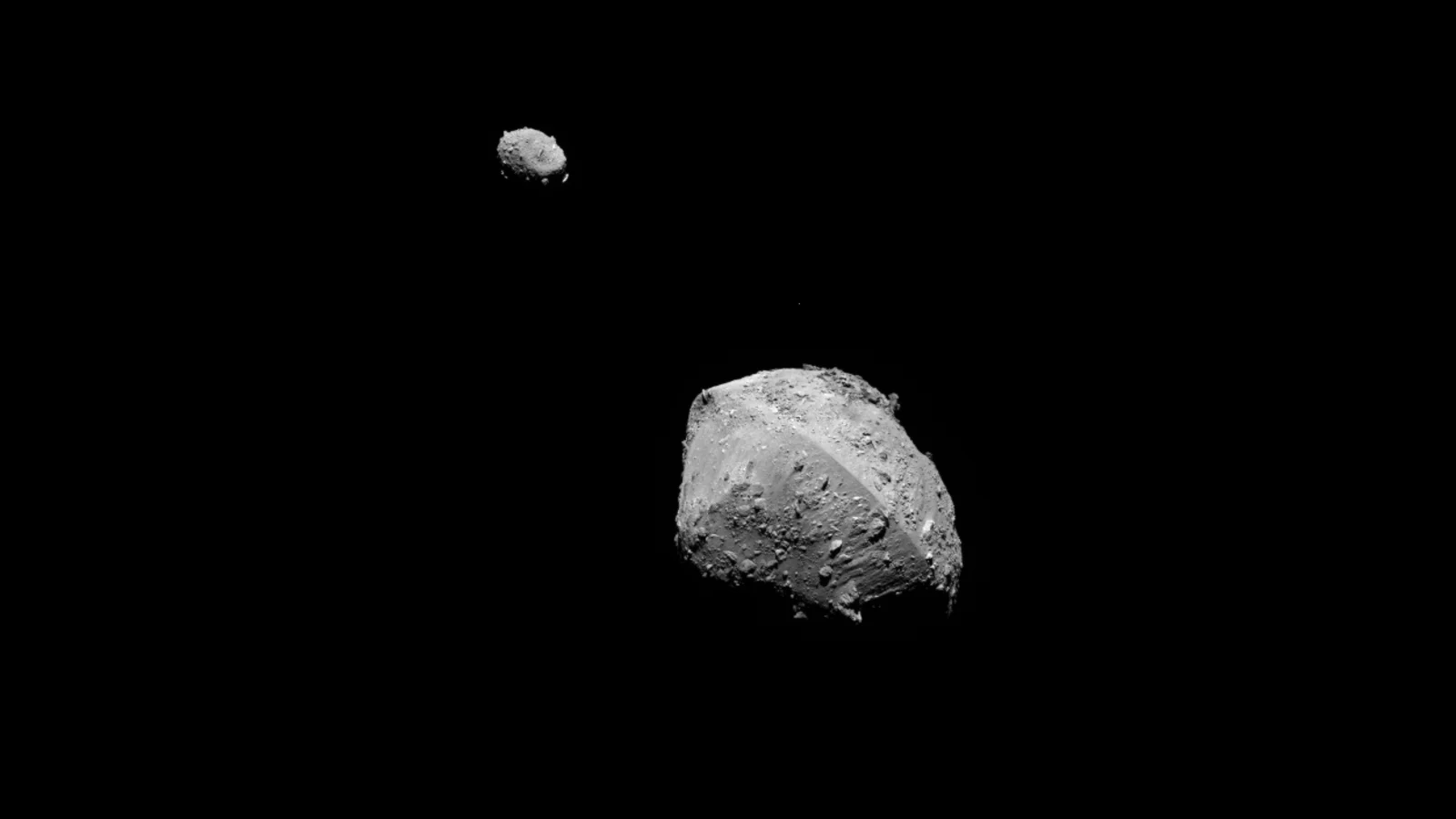
ESA’s Hera spacecraft has shown what NASA’s DART probe did to the asteroid it hit four years ago. Hera mission manager Ian Carnelli presented the first close images of Dimorphos on Wednesday, 25 November, in the dinosaur hall of the Museum für Naturkunde in Berlin. Patrick Michel, the mission’s principal investigator, described the result in ESA’s release:
Scientists debated whether Dimorphos had sustained an impact crater, changed its shape or stayed the same.
Much to our surprise the answer turns out to be all three at once! The face struck by DART has been flattened into an impact crater the size of a sports stadium, which extends across the asteroid's entire width.
 Patrick MichelHera principal investigator, CNRSESA press release, November 25, 2026
Elsewhere Dimorphos shows no sign of major change: ESA says its other boulder fields look as they did in DART’s images of 2022.
What DART did in 2022
DART, a 580-kilogram spacecraft, struck Dimorphos at 6.1 kilometres per second on 26 September 2022. The 151-metre moonlet circles the 730-metre Didymos about a kilometre away, and the impact shortened its orbit by about 33 minutes, much more than predicted. Telescopes on Earth measured that change but could not show what had happened to the asteroid itself, and ESA sent Hera, its first planetary defence mission, to find out.
As more images came back, said Michael Kueppers, ESA’s Hera mission scientist, “it became clear that the DART impact has left Dimorphos tumbling wildly in its orbit”. Hundreds of boulders a few metres across, orbiting both asteroids, were another surprise, the release adds; the team will have to account for them as Hera flies closer. In the dinosaur hall Carnelli said: “Sixty-six million years ago, an asteroid impact changed the course of life on Earth. Today, for the first time in history, humanity is validating how to prevent such an event from happening again.”
Closer in December, CubeSats in January
So far Hera has studied the pair from 25 to 30 kilometres away. Like BepiColombo, which entered orbit around Mercury on 21 November, it is flown from ESA’s mission control in Darmstadt.
- 7 October 2024Hera launchesA Falcon 9 lifts off from Cape Canaveral
- 11 November 2026ESA confirms Hera's arrivalIts early characterisation phase begins
- 25 November 2026First close images of DimorphosShown in Berlin
- December 2026Hera moves to about 13 kmSharper images of both asteroids
- January 2027Two CubeSats releasedJuventas and Milani fly closer still
Juventas, led by Luxembourg, carries a low-frequency radar to look inside an asteroid for the first time and will later try to land. Milani, led by Italy, will study the asteroids’ material and the dust around them.