In this material
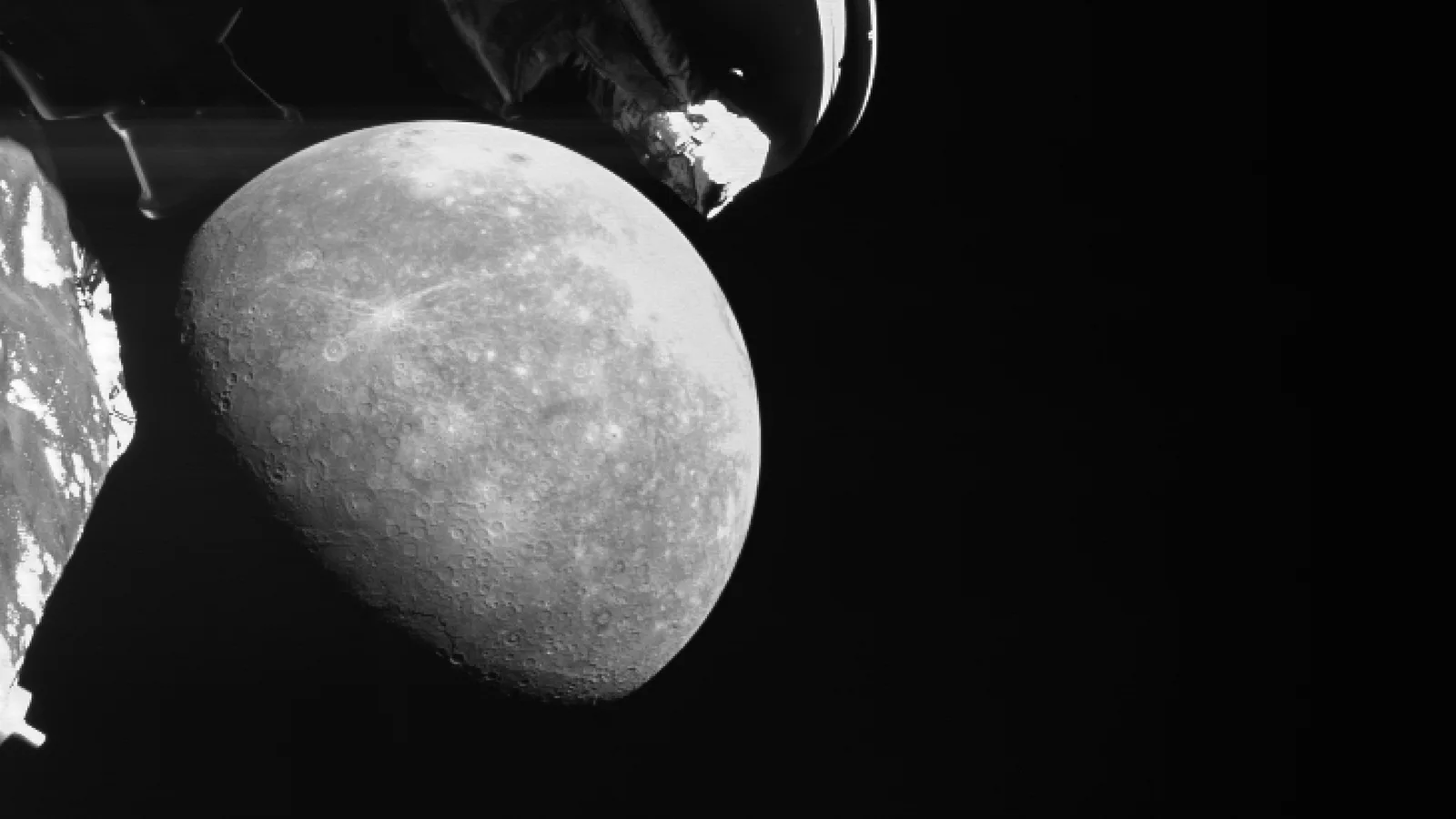
BepiColombo, the joint mission of the European Space Agency and the Japan Aerospace Exploration Agency, is in orbit around Mercury. At 18:24 UTC on Saturday the four chemical thrusters of ESA’s Mercury Planetary Orbiter (MPO) began a 37-minute burn through the closest approach to the planet, at an altitude of 635 kilometres. Shortly after 17:00 UTC the spacecraft had turned into the attitude needed for the burn, and mission control in Darmstadt lost its signal, as planned.
ESA had expected to hear from the spacecraft again at 21:37 UTC. The confirmation came on Sunday at 01:00 UTC, when ESA’s operations account wrote on X that “We’ve heard back from Bepi” and that the teams were “busy assessing the telemetry, but Flight Dynamics already has confirmed it achieved orbital capture around Mercury!” The mission’s own account repeated it two minutes later and promised an update on the next steps early next week.
The second mission to orbit Mercury
BepiColombo launched on an Ariane 5 on 20 October 2018. Only NASA’s Messenger had orbited Mercury before, from 2011 to 2015; Mariner 10 flew past it three times in 1974 and 1975. Because of the Sun’s gravity, ESA says, a stable orbit around Mercury takes more energy than a mission to Pluto.
BepiColombo shed its speed over 9.9 billion kilometres and nine flybys: one of Earth, two of Venus and six of Mercury. An issue that reduced the power from the solar arrays of its transfer module forced a change of route and moved the arrival from December 2025 to November 2026. The module separated on 3 September.
Two orbiters, then science
MPO and JAXA’s Mercury Magnetospheric Orbiter, called Mio, are still stacked together. According to ESA’s timeline, MPO releases Mio onto its own elliptical polar orbit on 9 and 10 December, drops Mio’s sunshield on 16 December and then uses its thrusters to descend towards its final orbit, which it reaches on 10 March 2027. The science phase is set to start on 6 April 2027. JAXA’s fact sheet of 20 November gives 9 December UTC (10 December in Japan) for the separation and April 2027 for the start of Mio’s regular operations.
Once they separate, BepiColombo will be the first mission with two spacecraft in orbit around Mercury. MPO is built to map the surface and its composition, while Mio studies the magnetic field and the plasma around the planet. In September, after the transfer module separated, ESA’s lead project scientist Geraint Jones called it a first step towards “finally being able to use all the powerful instruments on both MPO and Mio to study Mercury”.