In this material
SpaceX may put up to one million satellites into low Earth orbit to work as data centres. The FCC’s Space Bureau released the order on Wednesday, 25 November, ten months after SpaceX applied for Starmind. The satellites would compute on solar power and talk mostly through laser links to Starlink, so the grant covers only Ka-band radio for backup control. For scale, Jonathan McDowell counted 11,195 Starlink satellites in orbit on 26 November.
The American Astronomical Society, which had asked the FCC in March to refuse, said it was “disheartened and dismayed”. Design changes to Starlink had reduced the harm to research, though not removed it, the society wrote, but this plan “represents a fundamentally different initiative that is at odds with a spirit of cooperation and goodwill.”
What astronomers object to
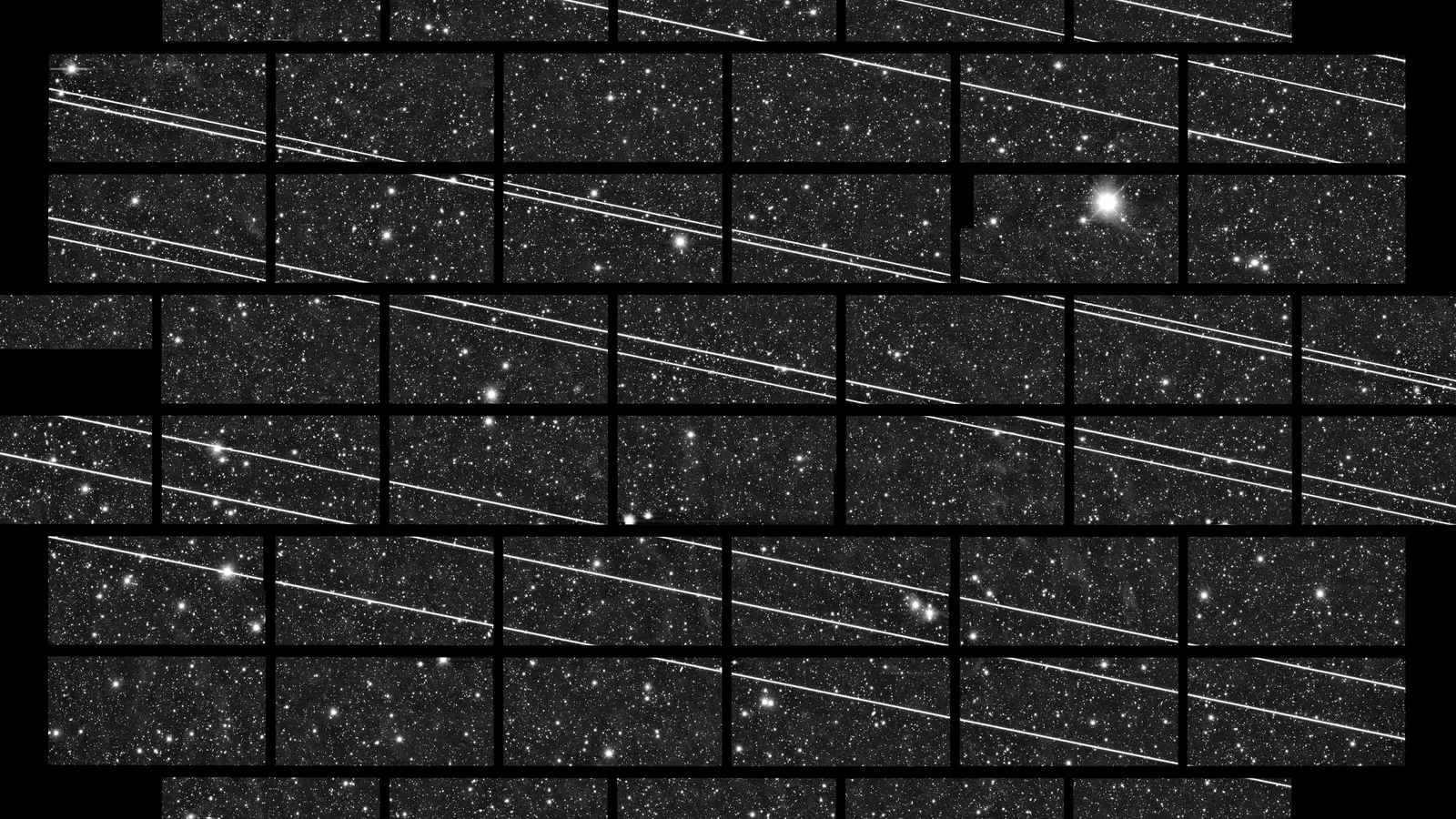
Starmind satellites would be larger, brighter and more numerous, on higher orbits, so they “would therefore be visible as extremely bright objects for longer periods in the night sky,” the AAS says. It also warns of radio emissions and of waste heat raising the infrared background. In March the Royal Astronomical Society estimated that an average image of ESO’s Very Large Telescope would lose 10% of its data to trails. Ground telescopes also follow up finds from space: Keck and the Large Binocular Telescope observed the most distant quasar known before Webb confirmed it.
Adam Becker, astrophysicist and author of More Everything Forever, a 2025 book on the futures Silicon Valley promises, called the plan “a fantasy”. “It’s not going to happen,” he told AP, citing “basic physical limits” to shedding heat in a vacuum. He also spoke of collisions:
You could end up with a cascading set of space junk collisions.
Such crashes could leave “a cloud of debris” in low Earth orbit, he said. “It also is pollution of the night sky to the naked eye.”
What the FCC decided
SpaceX’s debris plan passed only for satellites below 600 km; four of the six shells lie between 686 and 1,002 km. Before launching there, SpaceX must file a modification with a final debris plan. The rules set no limit on the number of satellites, and the Bureau declined to create one. Environmental review was not required, since an FCC order of October treats operations in space as outside US territory. Optical astronomy is covered by SpaceX’s promise to coordinate with the National Science Foundation, the order says; the AAS notes that the licence makes no such coordination formal.
SpaceX has 30 days to decline the grant with its conditions; if it does not answer, it has accepted them. If it misses one of the deployment deadlines below, the authorisation becomes void.
- 30 January 2026SpaceX appliesUp to 1,000,000 satellites between 500 and 1,002 km
- 6 March 2026Petitions to denyKuiper Systems, Viasat and the AAS
- 25 November 2026FCC grantGranted in part, deferred in part
- 25 November 2033First satelliteDeployed and operating
- 25 November 203510% of the constellation100,000 satellites
- 25 November 2038Half of the constellation500,000 satellites
- 25 November 2040Full constellation1,000,000 satellites