In this material
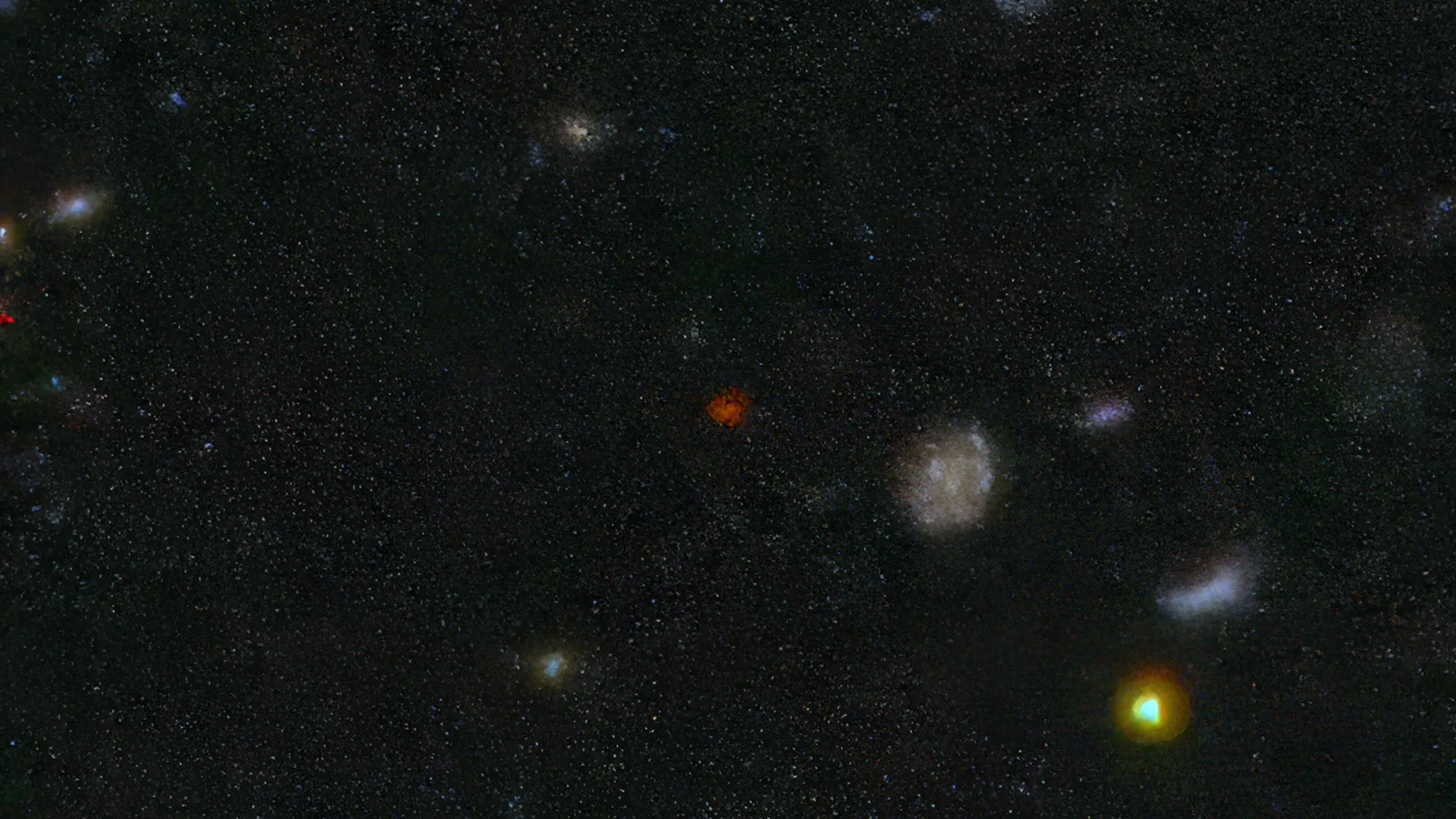
Euclid has found the most distant quasar known, ESA and the Max Planck Institute for Astronomy (MPIA) in Heidelberg announced on Tuesday, 24 November. J1504+6252 was picked out among millions of objects in about 18 months of Euclid survey data. Keck and Hubble gave the first hints, the Large Binocular Telescope followed, and the James Webb Space Telescope confirmed a redshift of 8.13.
The team nicknamed it Dún Aonghasa, after a prehistoric cliff-top fort at the Atlantic edge of Ireland, because the quasar, like the fort, stands at the present frontier of what can be observed. Julien Wolf, who led the team at MPIA and now works at the European Southern Observatory, said in the institute’s release:
Finding quasars at ever-increasing distances, at the edge of the observable universe, teaches us something about how the black holes in their centres grew.
The closer to the Big Bang we find them, the faster their black holes must have grown or the more massive they must have been at birth - or both.
A black hole that grew fast
A quasar is the core of a galaxy whose supermassive black hole is pulling in gas that heats up and outshines the whole galaxy. This one now feeds far below the Eddington limit, the rate at which the light of the hot gas starts to push infalling gas away. Had it always grown that slowly, MPIA writes, it would have needed an extremely massive seed, which points to much faster growth in the past.
Wolf’s team worked out which scenarios could build such a black hole in time. Their result seems to fit a direct collapse, in which a huge gas cloud turns straight into a black hole that keeps growing. Such conditions must have been rare, which could explain why so few quasars are known beyond redshift 7.5.
Euclid’s second record this year
- January 2021J0313-1806, redshift 7.64About 670 million years after the Big Bang
- July 2026Euclid reports 31 quasars, the farthest at redshift about 7.77Julien Wolf among the authors
- 24 November 2026Euclid's J1504+6252, redshift 8.13About 630 million years after the Big Bang
Eduardo Bañados, who leads a research group at MPIA, said it is unclear how far back such black holes go, “but Euclid has a good chance of finding out what that limit is”. If quasars turn up much closer to the Big Bang, the release adds, even a direct collapse becomes less likely, and astronomers may have to consider primordial black holes, hypothetical objects formed right after the Big Bang.