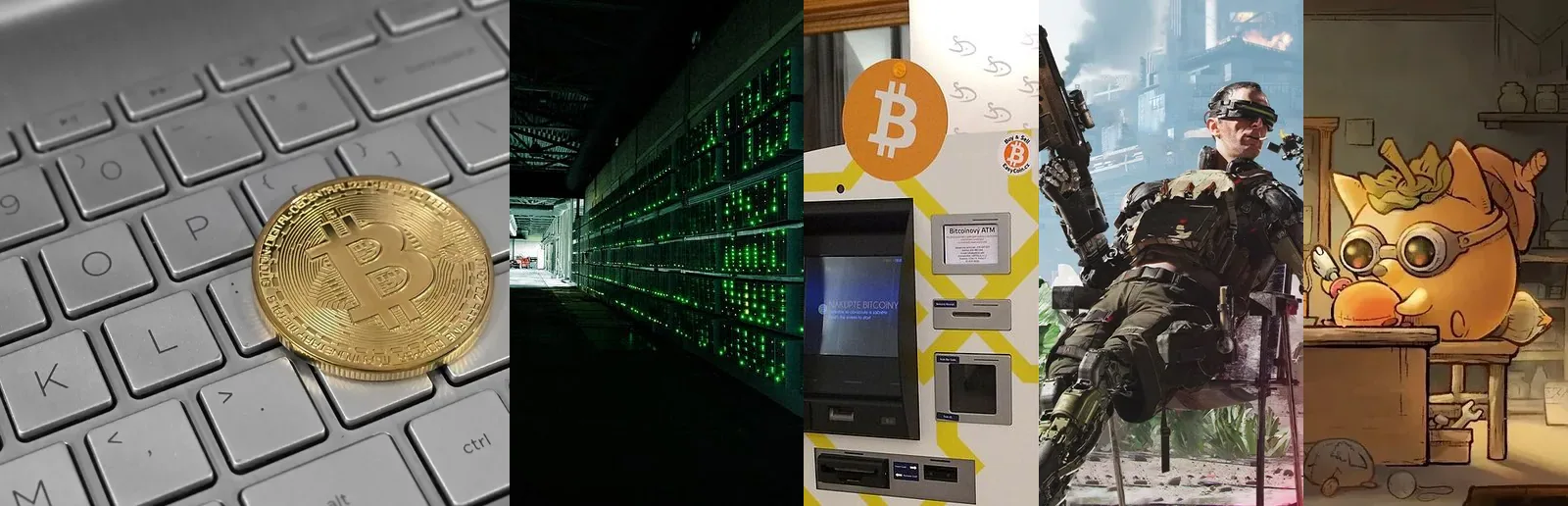
Data of November 16, 2026
Crypto scams aimed at players and how to check a site
Six ways players lose accounts, skins and coins to crypto scams, each on a real screenshot with the sign it gives itself away by, and how to check a site.
Art: Satheesh Sankaran / Wikimedia Commons (CC BY 2.0), Marko Ahtisaari / Wikimedia Commons (CC BY 2.0), Perituss / Wikimedia Commons (CC0), Gunzilla Games, Sky Mavis


-
1"Vote for my team" phishing
A friend's hijacked account asks you to vote for a team or join a CS, Dota 2, LoL or PUBG tournament. The page draws a fake Steam login window inside itself and passes the login, password and Steam Guard code to the attackers.
The signA real Steam login pop-up gets its own button on the taskbar and can be resized; a drawn one cannot leave the browser window.
A caseIn July 2022 Group-IB counted more than 150 phishing sites imitating Steam with this fake window (report of September 13, 2022). Source
-
2API key theft in trades
After a phishing login, the attacker registers a Steam Web API key on the account and watches its trade offers. When you trade, a bot cancels the real offer and sends a near-identical one from its own account, which you then confirm.
The signA key you did not create on the Steam Web API key page, or a trade confirmation that names a different account from the one you are trading with.
A caseIn July 2025 Valve added Trade Protected items to CS2: a player who lost control of the account or was scammed can reverse the trades of the past seven days. Source
-
3Fake airdrops and token sales
When a game or token is in the news, sites appear that promise an airdrop, tokens at a discount or a way to cash out in-game coins. They ask for a Telegram login, wallet details or a "commission" and take the account, the wallet or the money.
The signFree tokens that require a login, wallet details or a payment first, on a site that is not the project's own.
A caseIn July 2024 Kaspersky described fake Hamster Kombat airdrops and sites promising to turn game coins into roubles, built to steal Telegram accounts and wallet data. Source
-
4Wallet drainers posing as games or skin sites
A program or site dressed up as a game, a mod or a skin marketplace gets at a crypto wallet: it asks you to connect the wallet or searches the computer for wallet data. Then it moves the funds to the attacker.
The signA game, mod or trading site that wants a crypto wallet connection or a seed phrase when the task needs neither.
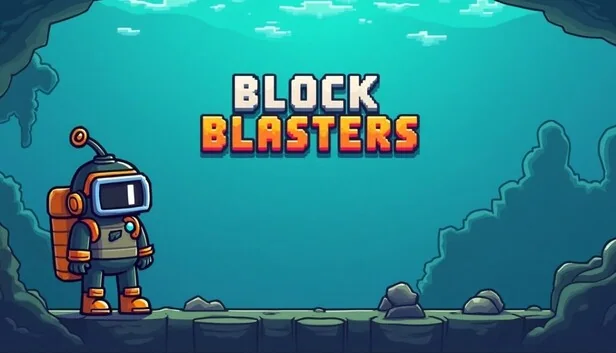
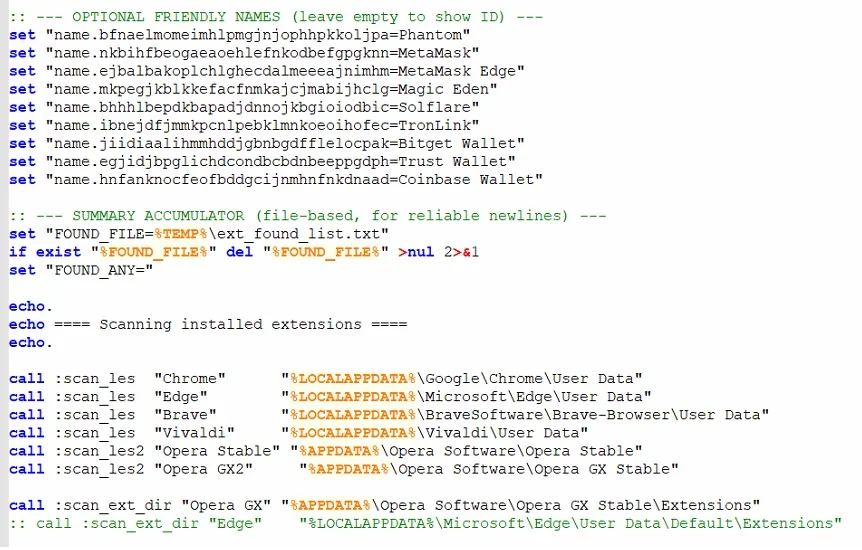
A caseIn September 2025 the Steam game BlockBlasters, which had malware added in an August update, stole $32,000 in crypto from a streamer; the game was then removed from Steam. Source
Picture 1 The cover of BlockBlasters, a 2D platformer released on Steam on July 31, 2025. Nothing about it looked wrong and it had hundreds of positive reviews; the malicious files arrived with an update on August 30, 2025. G DATA CyberDefense; game art by Genesis Interactive
Picture 2 A piece of a script from that update: a list of browser crypto wallets it looks for, among them Phantom, MetaMask, Solflare, TronLink, Trust Wallet and Coinbase Wallet, and the browsers it scans. G DATA CyberDefense
-
5Fake tournament streams and giveaways
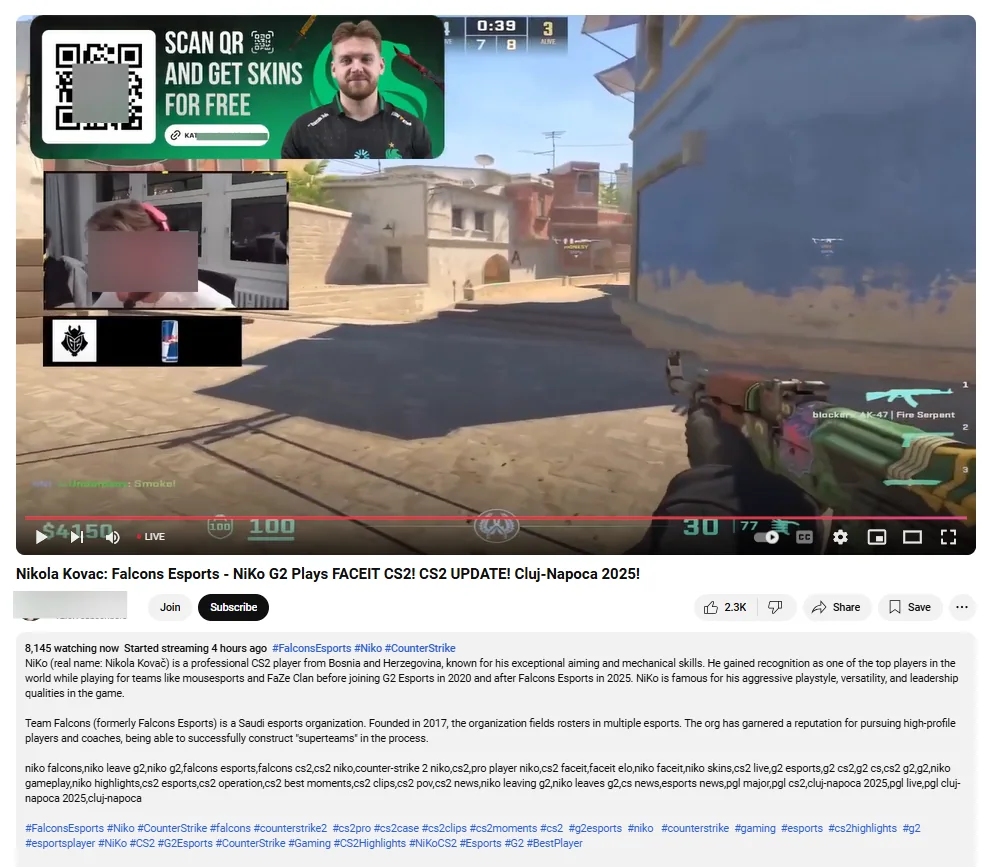
Hijacked YouTube channels are renamed after star players and loop old match footage with a QR code for free skins or crypto. The link leads to a fake Steam login that takes the inventory, or to an offer to send crypto and get double back.
The signA giveaway that needs your Steam login or a crypto transfer first, on a channel whose history does not match the player's name.
A caseDuring IEM Katowice 2025 and PGL Cluj-Napoca 2025 such streams posed as s1mple, NiKo and donk, Bitdefender reported on February 20, 2025. Source
In the picture A YouTube stream posing as NiKo: over old match footage hangs a banner "Scan QR and get skins for free". The title names two of his teams at once, Falcons and G2, next to Cluj-Napoca 2025, and the page shows 8,145 viewers. Bitdefender
-
6Fake support and verification pages
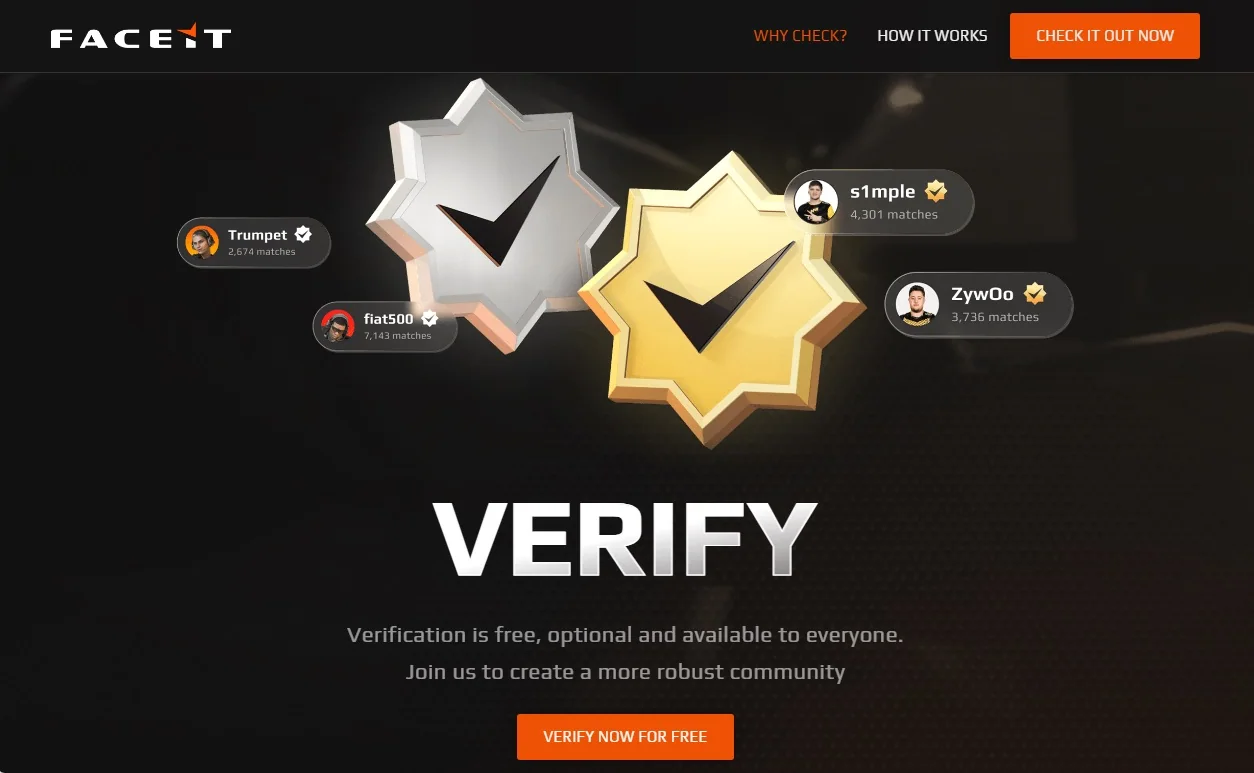
A message about a problem with your account sends you to a page that looks like a service you use, such as FACEIT, and asks you to verify yourself. Its "Sign in through Steam" button opens a copy of the Steam login inside the page, and some victims are also told to move items to a "backup" account.
The signUrgent talk of an account problem, a domain that is not the service's own, and a login window that lives inside the web page.
A caseIn June 2026 Malwarebytes described fake FACEIT verification pages on look-alike domains that stole Steam accounts and items. Source
In the picture A copy of a FACEIT page that offers free verification. It opened on look-alike domains such as faceit-discord.com, not on faceit.com, and its sign-in button showed a fake Steam window drawn inside the page. Malwarebytes
How to check a site
Open a site by its address or from the official channel of the project, not from a link in a message, a stream or a comment. A fake copies the design, not the domain: a Steam login opens on steamcommunity.com, and a login window drawn inside the page is a fake. Group-IB counted more than 150 such sites in July 2022.
Never type a seed phrase or a private key anywhere: no support, airdrop or verification needs it. Before signing a transaction, read what it allows; a drainer asks for permission to move every token of the wallet. Check a token by its contract address on the site of the project, not by its name: anyone can issue a token with the same name.
In CS2, trades of the last seven days can be reversed since July 2025: Valve calls it Trade Protection.
Questions people ask
What is a wallet drainer?
A site or an app that asks the wallet to sign a permission to move its tokens. After the signature the tokens are taken.
What if I typed my seed phrase on a site?
Move the coins to a new wallet with a new seed phrase at once: the old phrase is in the hands of whoever made the site.
How to tell a real airdrop?
A real one is announced in the official channels of the project and never asks for a seed phrase, a deposit or a login to another site.
Nothing in this section is advice to buy, sell or hold anything. A price is a dated fact with the page it was read on. Crypto is a high-risk asset and may be restricted or unlawful where you live.