In this material
Stars that swallow their partners have been predicted for decades, but no one had watched it happen. A team led by Viraj Karambelkar, a NASA Hubble Fellow at Columbia University in New York, has now watched a star in the Andromeda galaxy pull in its companion and, most likely, merge with it. The paper was published in Nature on 18 November 2026, and Karambelkar described his reaction to Space.com:
I was absolutely flabbergasted when we saw this.
“Catching a star engulfing its companion in the act is very difficult,” he added: the effect builds up slowly, and only sensitive telescopes that watch the sky for a long time can catch it.
How the companion spiralled in
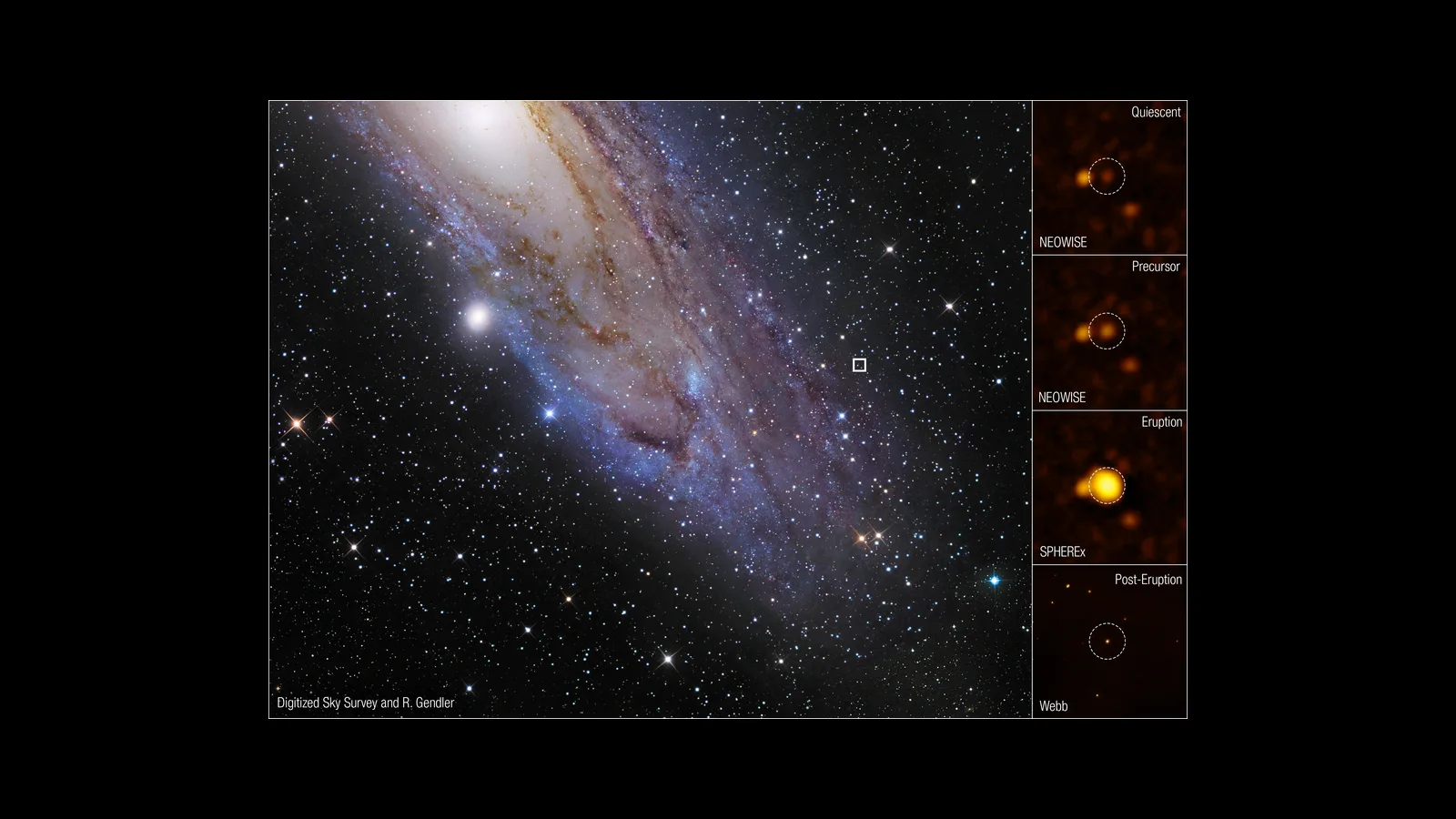
The system, formally AT 2025abao and nicknamed Bao, lies at the edge of Andromeda. Its larger star was a giant late in its life, about seven times as massive as the Sun, 350 times wider and 18,000 times brighter, according to NASA. The team’s models also give the first estimate of the companion’s mass: about 0.7 solar masses. Once the small star touched the surface of the giant, it took only seven orbits, about seven years, to spiral in through their shared envelope of gas.
The star kept a steady brightness from 1989 until 2018, when it began to brighten. The team noticed it in data from NASA’s NEOWISE in February 2023, and the Zwicky Transient Facility recorded the eruption on 17 October 2025. Webb took three hours of mid-infrared data on 24 December 2025, which let the researchers trace the dust the giant had shed and measure how much material the eruption threw out: about the outer tenth of the star’s envelope, the paper says.
Not settled yet
NASA writes that Webb’s data proved the two stars merged. Karambelkar is more careful. A merger is “not the only possibility,” he told Space.com:
The other possibility is that both stars survived, in a much shorter orbit. In order to conclusively determine what happened, we need to continue monitoring what the system does, once the heft of the eruption settles down.
He expects more such events from NASA’s Nancy Grace Roman Space Telescope, whose survey of the galactic bulge will find large numbers of changing objects, and from the Vera C. Rubin Observatory. “There’s going to be a large influx of similar discoveries just ahead,” he said in NASA’s release.